
The Carretera Austral
From rainforests to glaciers in North Patagonia

Puerto Varas to Villa O’Higgins (1st - 24th February)
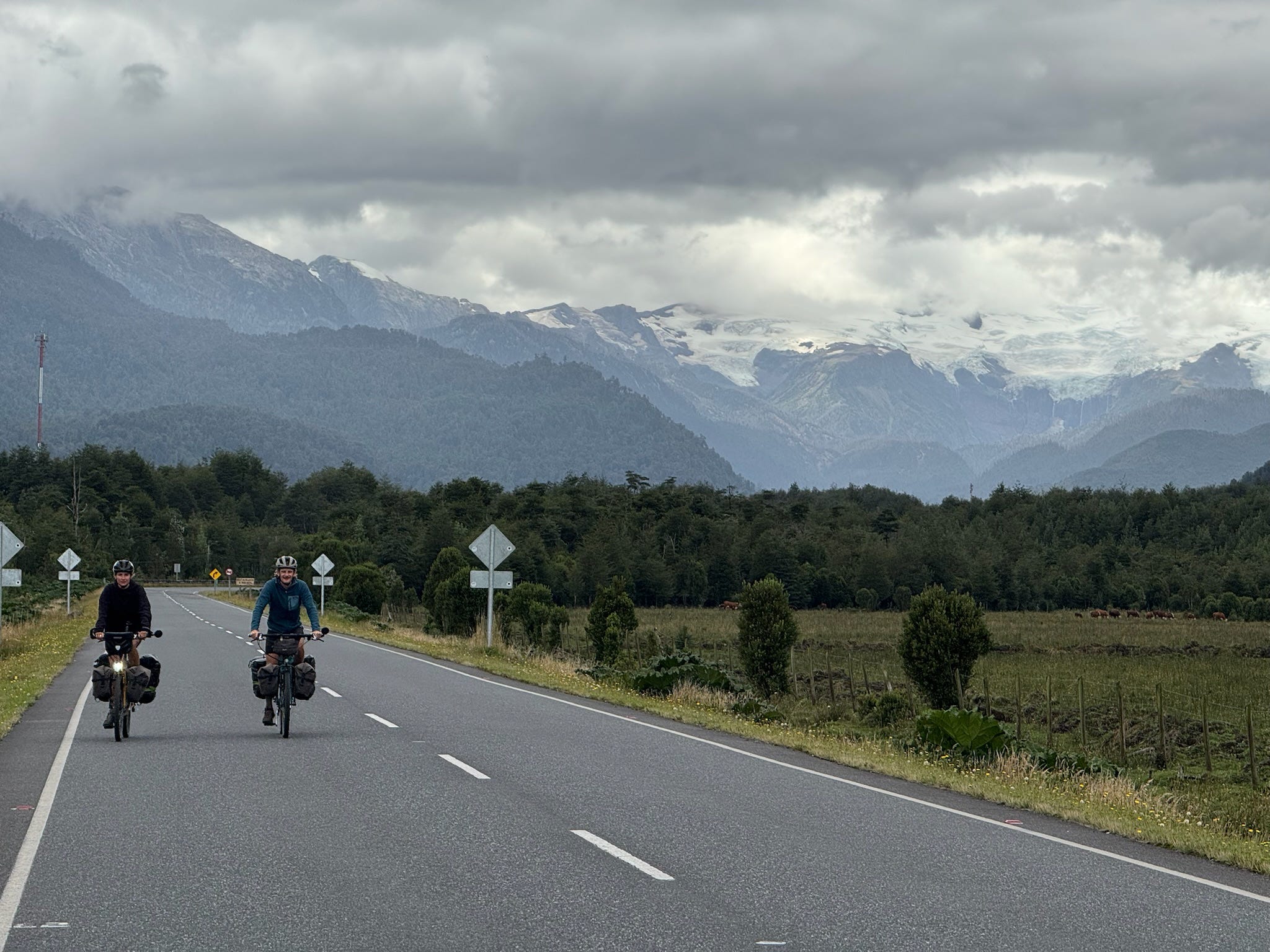
The world’s most beautiful road
A couple of years ago, when the idea of quitting our jobs and heading off on a bicycle adventure was first starting to formulate, Patagonia was the one place that was at the forefront of our minds. Throughout the trip it had always felt so far away; but now, all of a sudden, we were heading into the wilderness at the bottom of the world.
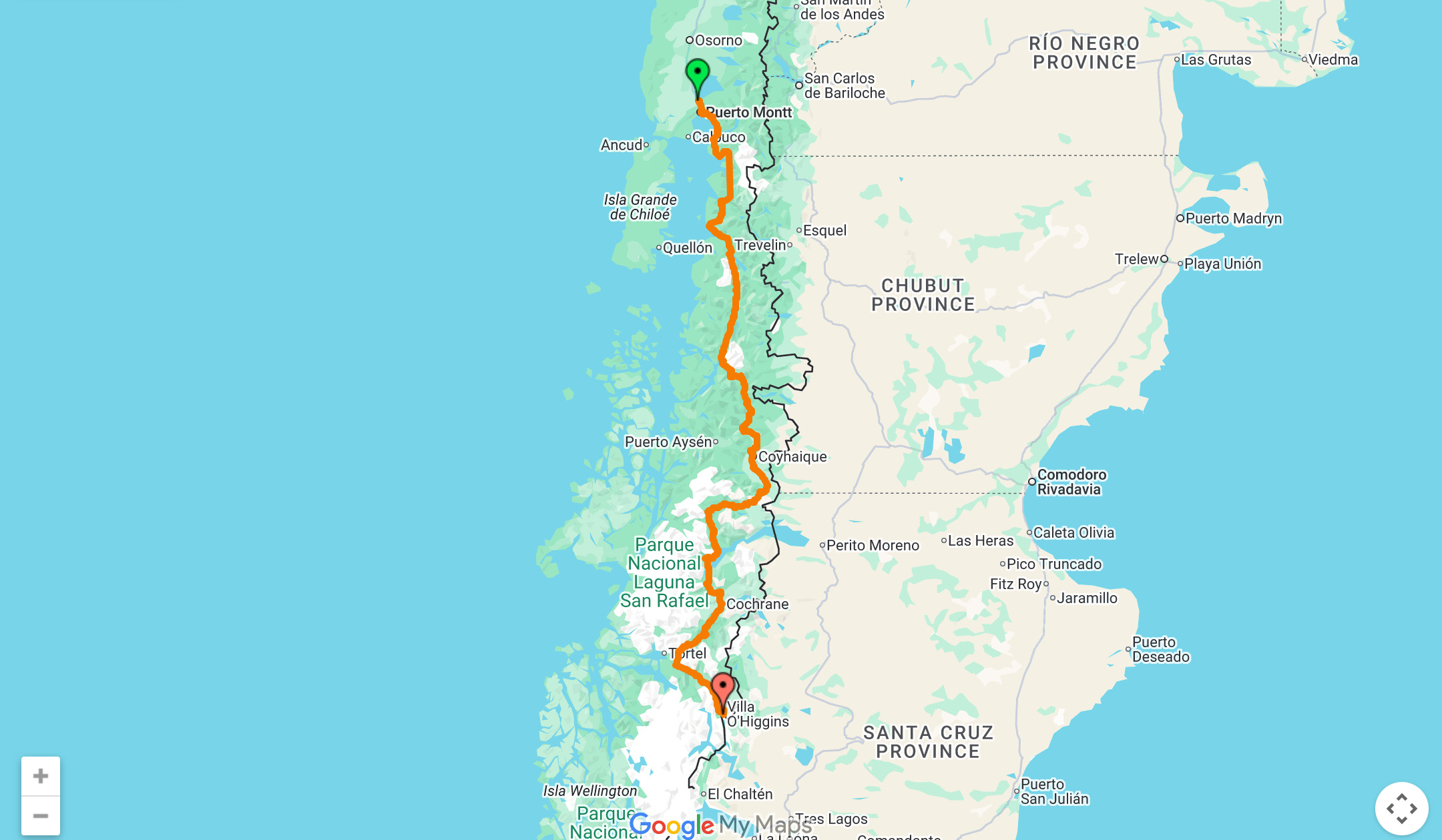
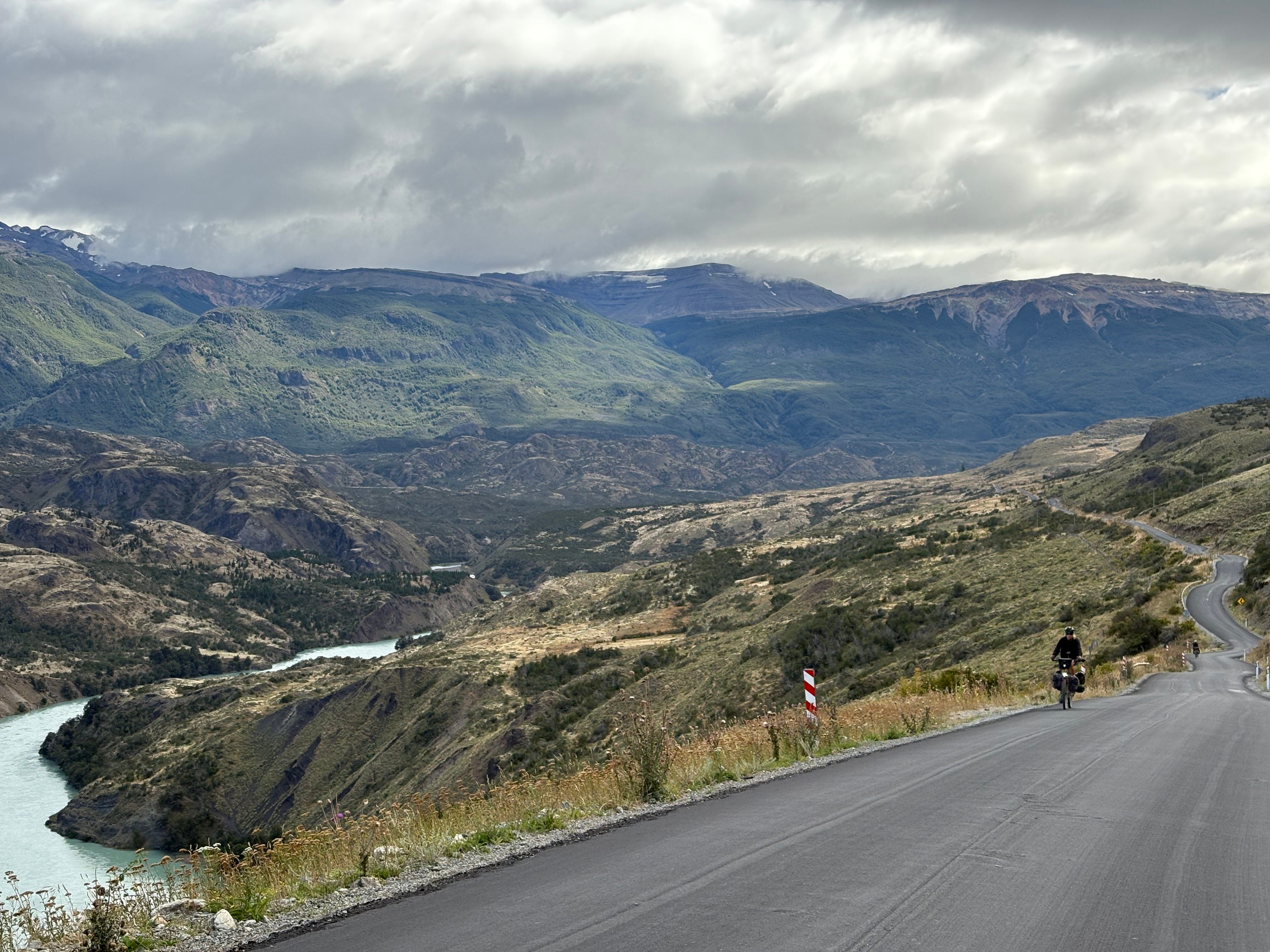
For the first half of our Patagonian journey, we would be travelling down Chile via the rugged, remote, and frankly downright bonkers Carretera Austral. The ‘Southern Road’ is a 1200km half paved, half gravel highway that runs from Puerto Varas all the way south to Villa O’Higgins, a small outpost that sits on the edge of the South Patagonian Ice Field.
Construction of it started in 1976 under the military government of Augusto Pinochet, with the intent of physically integrating the deep south with the rest of Chile. The final section was only completed in 2000. Safe to say, it’s wild.
In recent years, it has become the go to cycle touring route in South America. A beautiful, straightforward way to continue the journey south. Keep the ocean on the your right, the mountains on your left, and stick on Ruta 7. Listo.
Two becomes three
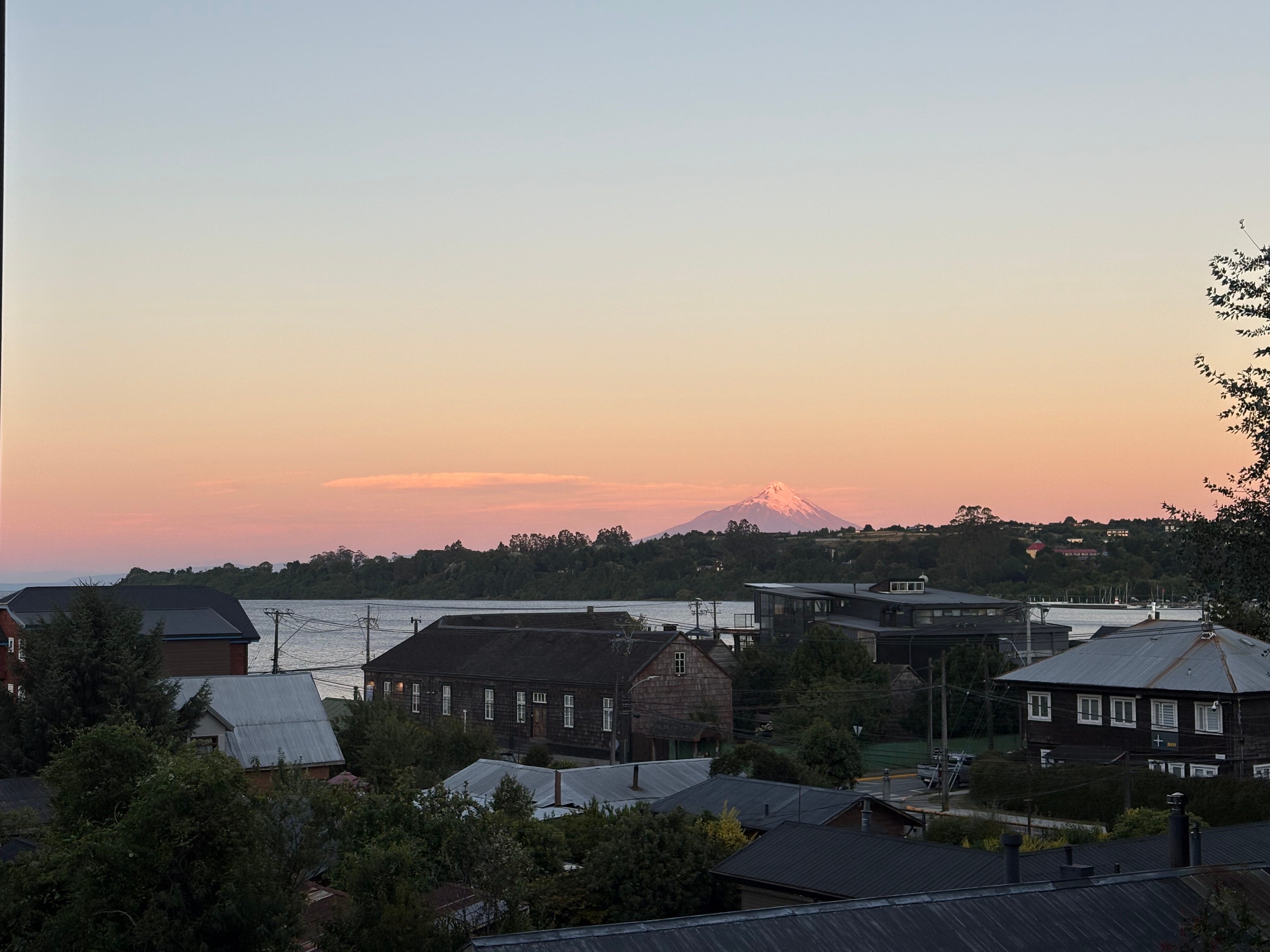
As well as long distance tourers using it as part of a journey south (or north!), the Carretera is also a heralded route to ride in its own right. As a result, there is a fantastic amount of cycling infrastructure all along the road. Including a brilliant company called Austral Bikes, which provides a rental service where you can pick up a bike, bags and camping equipment in Puerto Varas and drop it off at various locations along the way. If ever we were going to have someone come and join us for a section of the trip, this was it.
Hence, the arrival of our surprise guest - James (or Poy, as he is more commonly known). Who having just sailed across the Atlantic, had decided he needed even more adventure in his life and was going to join us for the ride down the Carretera. He turned up in cream trousers (good luck with those), a day late, having never done a day of cycle touring in his life. What could possibly go wrong?
Regardless, it was great to see a friendly face, and we were excited for the fresh energy having a new riding partner would bring. We picked up his rental bike + camping gear from Austral Bikes, treated ourselves to a bottle of wine, and prepared to head into the Patagonian wilderness.
Settling in
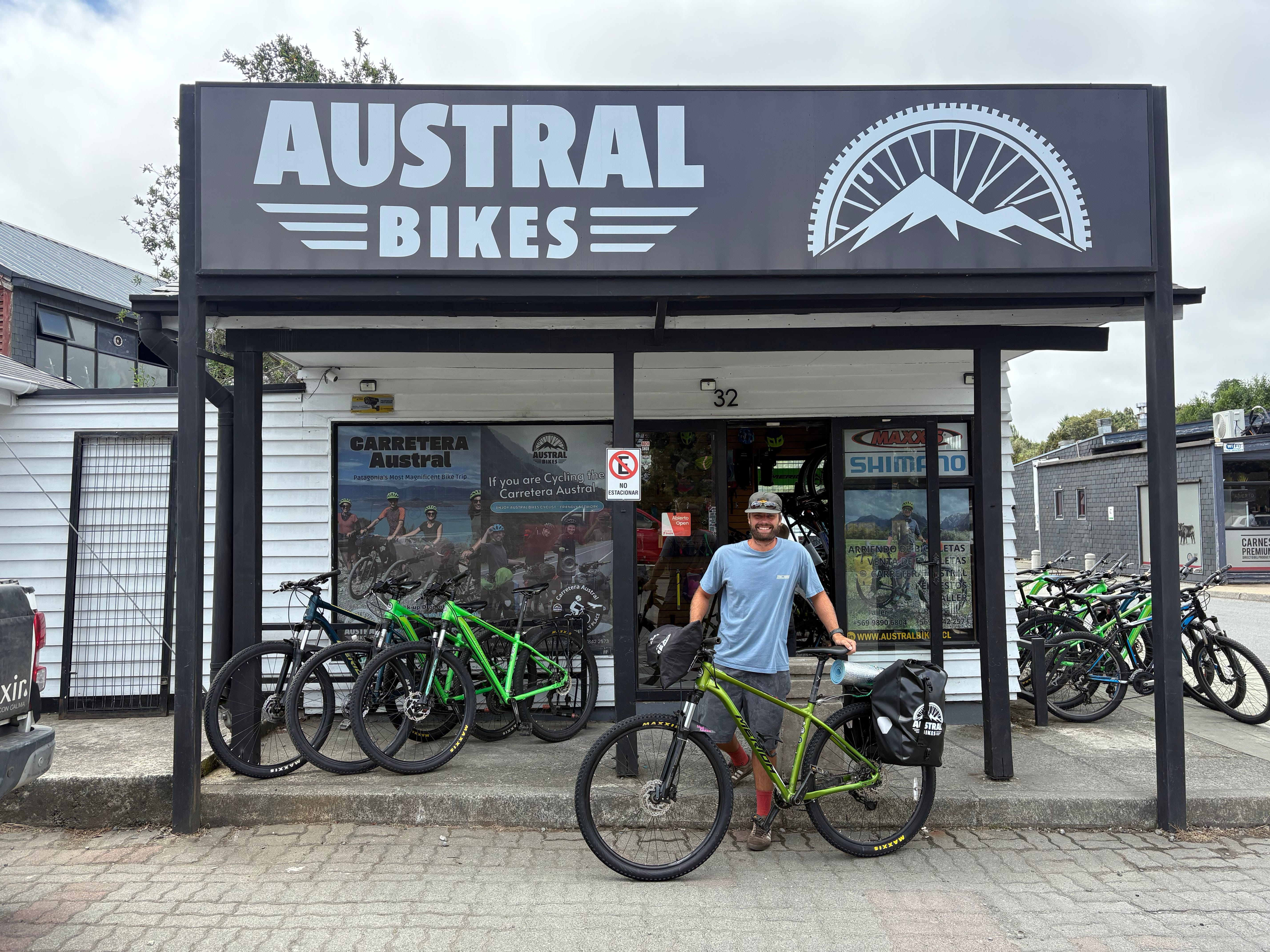
The first section of the Carretera from Puerto Varas hugs the coast of the Golfo Corcovado, an enormous open gulf that separates mainland Chile from Chiloé island. Due to a combo of it’s proximity to the Pacific, the prevailing westerly winds, and the Andes mountains inland, it’s one of the wettest parts of Patagonia. Our first few days gave us an opportunity to make sure our waterproofs were still in working order, and tick off a number of firsts for Poy; first day cycling with panniers, first time putting up the tent, first meal cooked on a camping stove.


End of the prologue
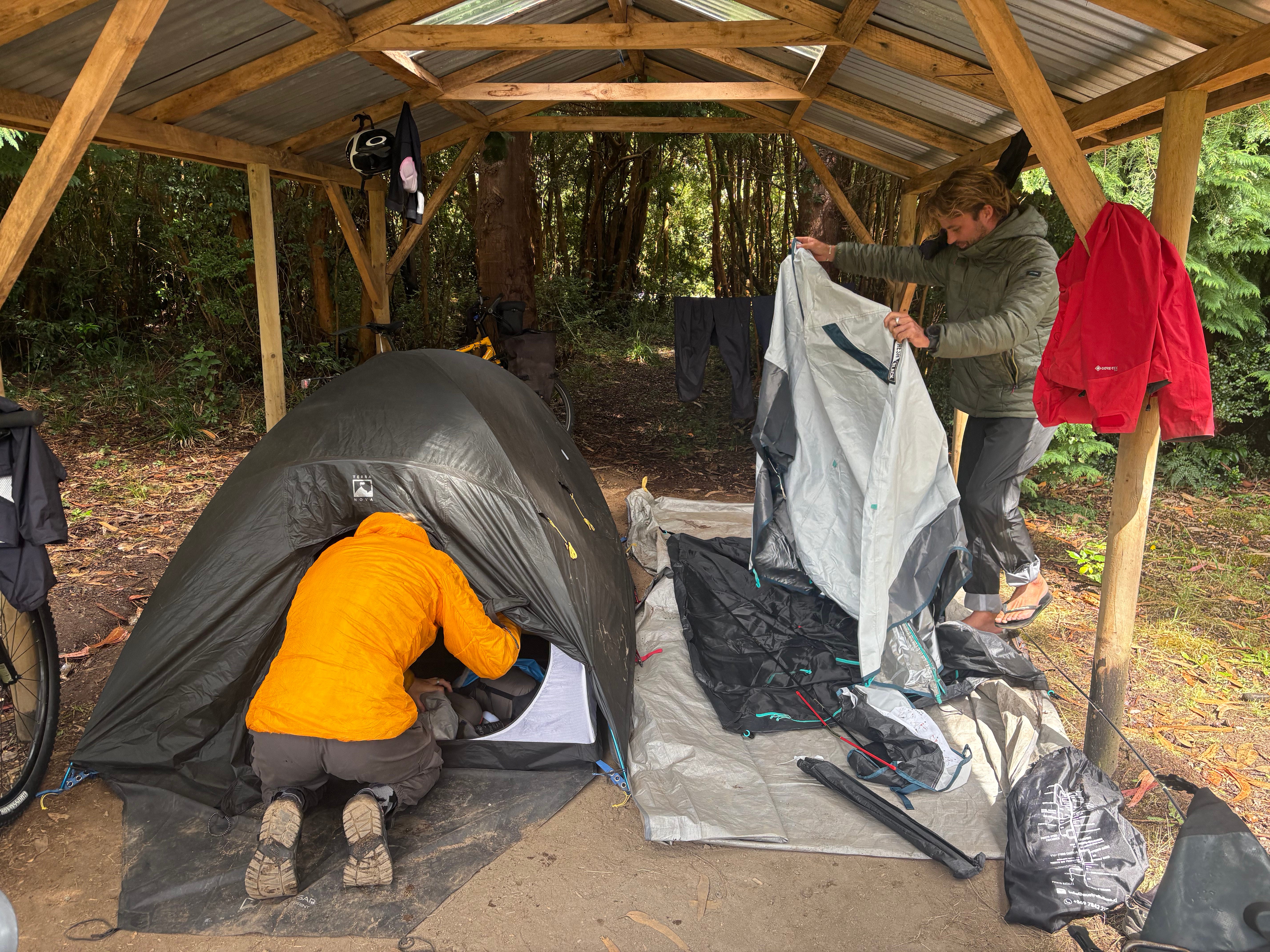
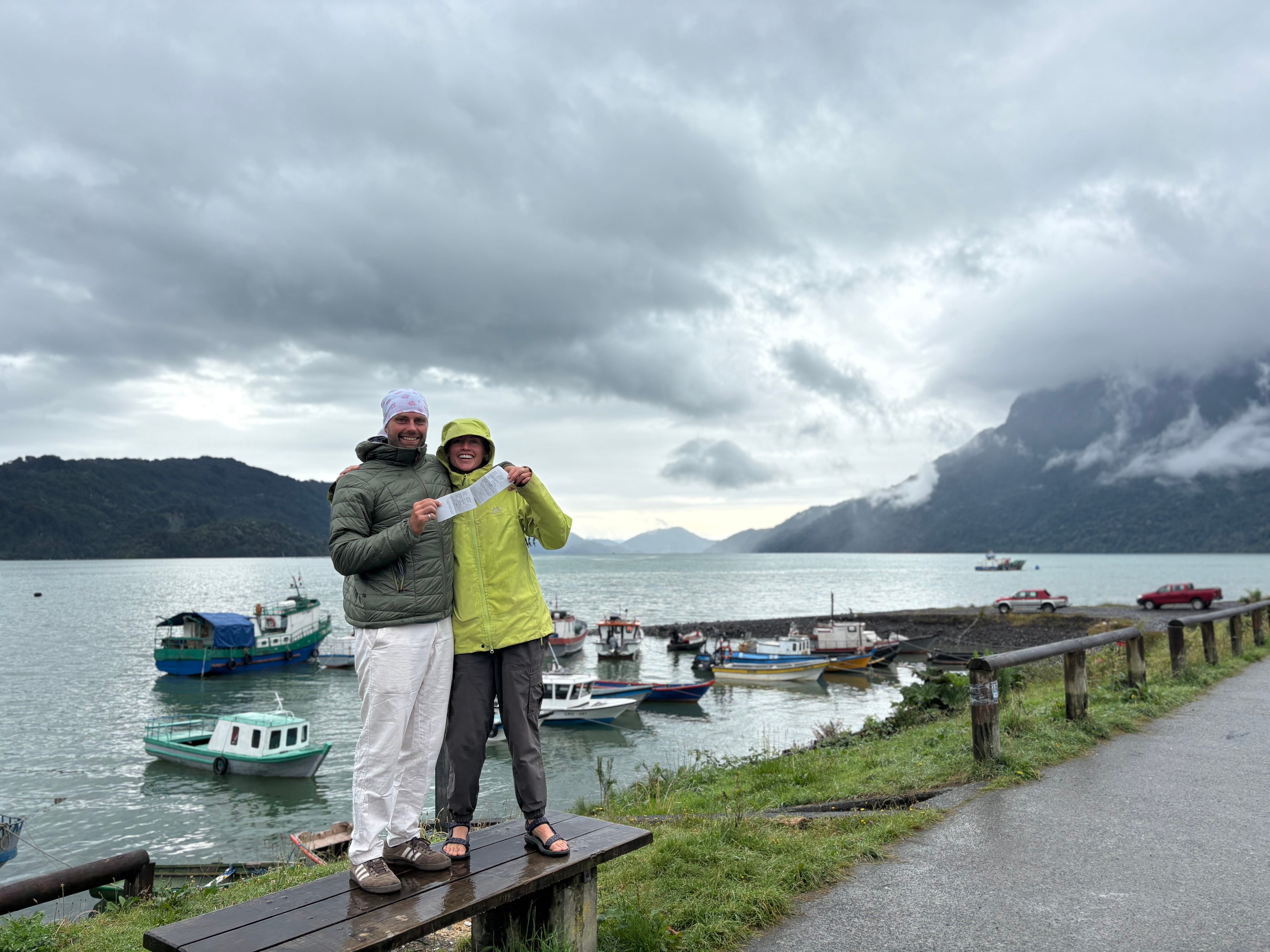
The trouble with building a road that hugs the coast in Northern Patagonia is the myriad of fjords, with banks that consist of steep mountainsides covered in vegetation. The solution to this challenge employed by the wily Carretera road builders was to dead end the road in serval places, and connect them up with ferry crossings across the fjords. The most significant of these is the ‘Bi-Modal’ ferry; a three part journey from the small settlement of Hornopiren consisting of a boat ride, a road section, and a second boat ride all packaged up into a single ‘crossing’. It’s a real bottleneck, particularly in the busy summer months, and gets booked up way in advance with Overlanders heading down to explore Patagonia. We arrived in town a little nervous about whether we could squeeze onto the ferry, and headed straight to the ticket office where we were told it was full, but to come back later. When we came back later, we were told it was no problem at all and had our tickets printed in an instant. South America being South America. We dryed our soaking kit by the fire in our little Cabana, excited to be getting stuck into the real stuff.


Free km’s and new friends
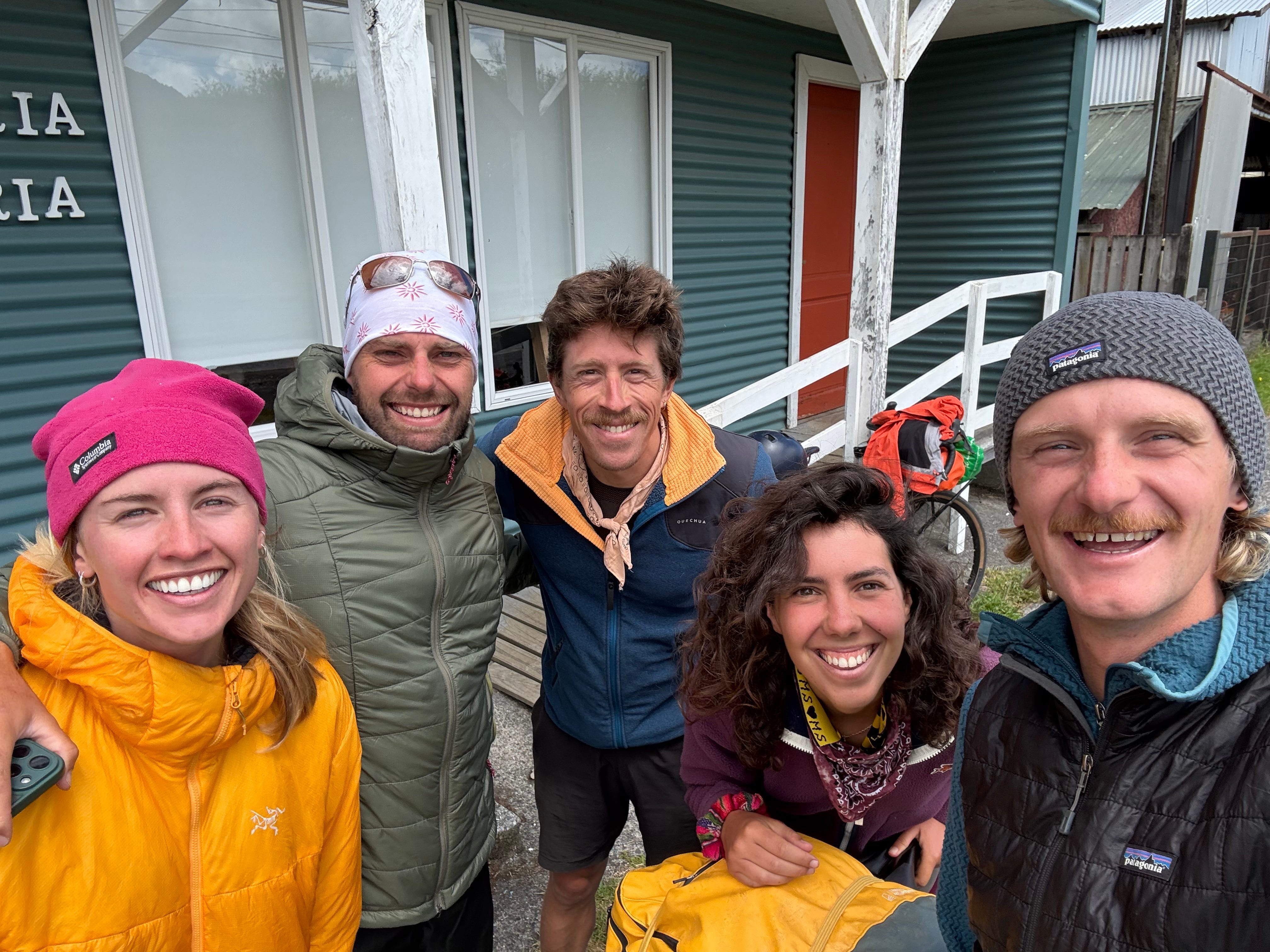
After a 4 hour delay due to ‘unexpected tides’ (which is a little hard to believe, given tides are one of the most reliable, foreseeable things in the world), we set off on a stunningly beautiful journey down the fjord under the towering peaks of Hornopiren National Park. Along the way we got chatting to Etienne and Coline, a French couple who we discovered had ridden almost the exact same route as us, and were also destined for Ushuaia. As we arrived at the docking point, rumours began to circulate that the ferry across the second fjord departed in 30 minutes, and any cars or bicycles that missed it would have a 1.5 hour wait for a subsequent ferry. Cue a pedal to the metal, 10km time trial which along with nearly killing Poy, got us to the ferry ramp just as it was closing it’s door and casting off. Ah well, it was good fun. And there’s definitely worse places to have to kill an hour and a half.


Into the jungle
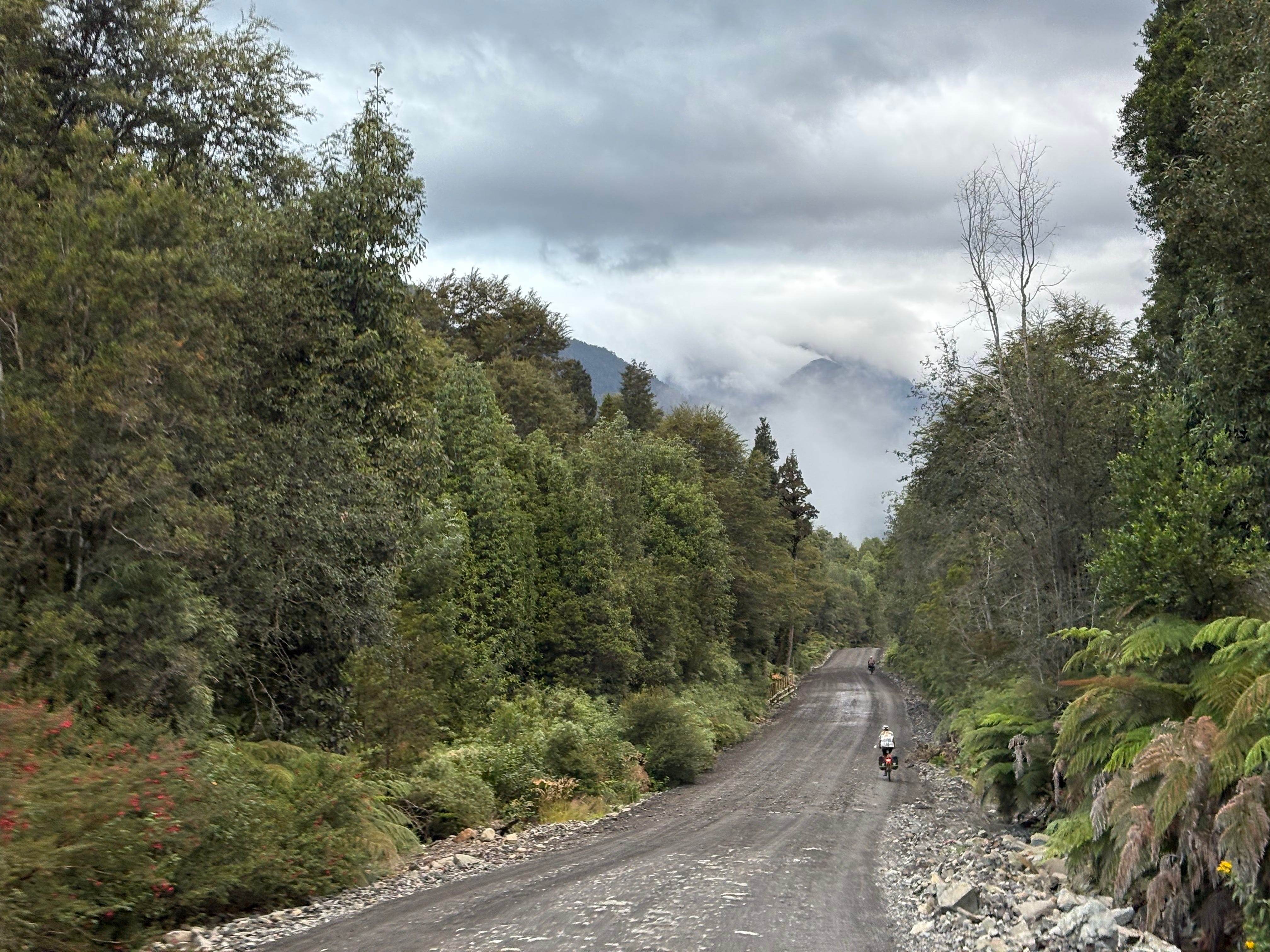
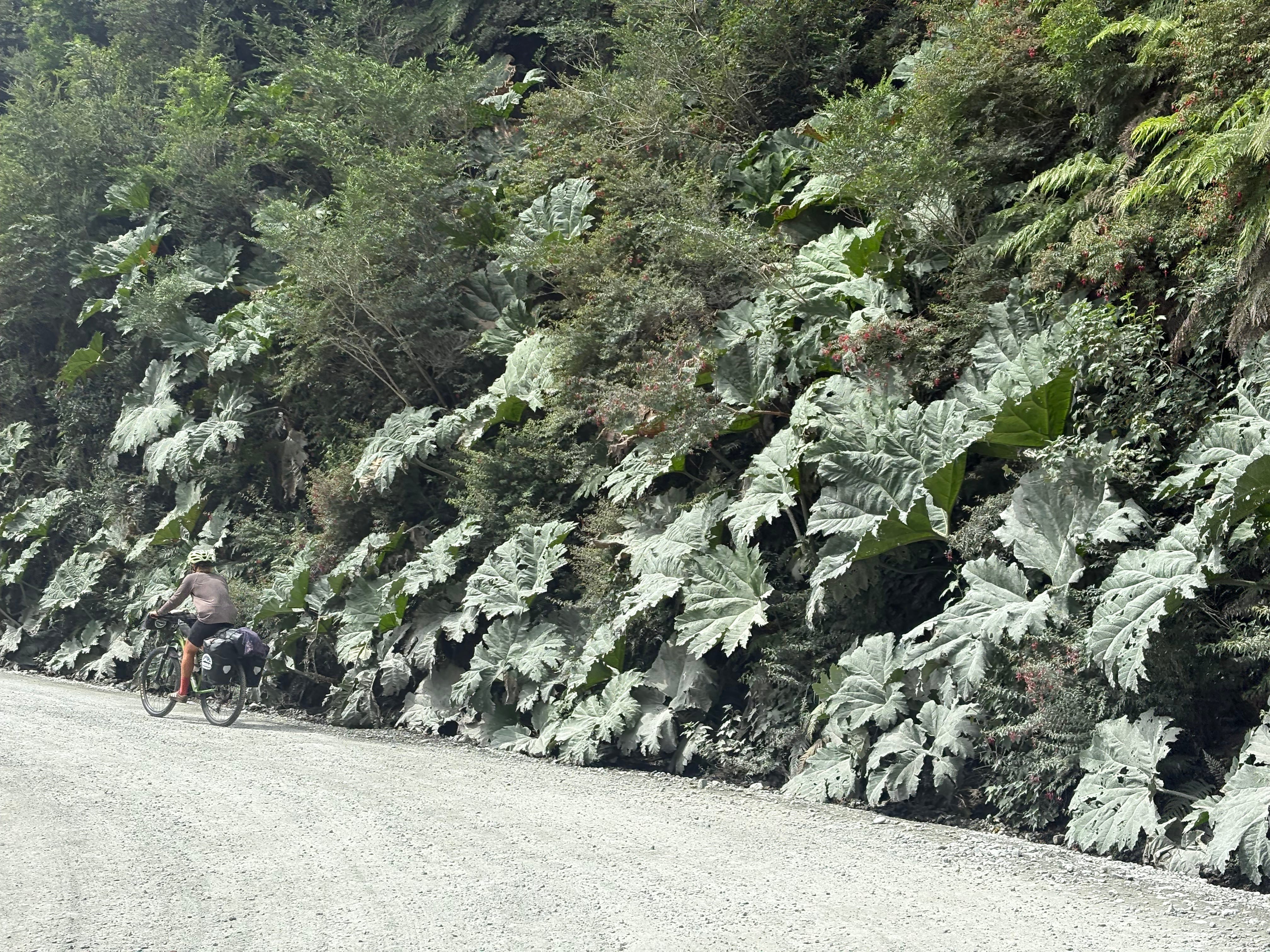
We had expected to see lots of things in Patagonia, but a lush temperate rainforest was not one of them. Turns out the mild temperatures and high rainfall make this a perfect climate for dense jungle foliage, much like what we had ridden through in Olympic National Park up in the Pacific Northwest. We breezed across the second fjord, and stepped off the ferry into what felt like the set of a Jurassic Park film. After riding into the dusk with our new French friends, we made camp for the night on the shores of Lago Negro under a canopy of ferns the size of our tent. It was a magical end to a memorable day.


Actual Champagne Touring
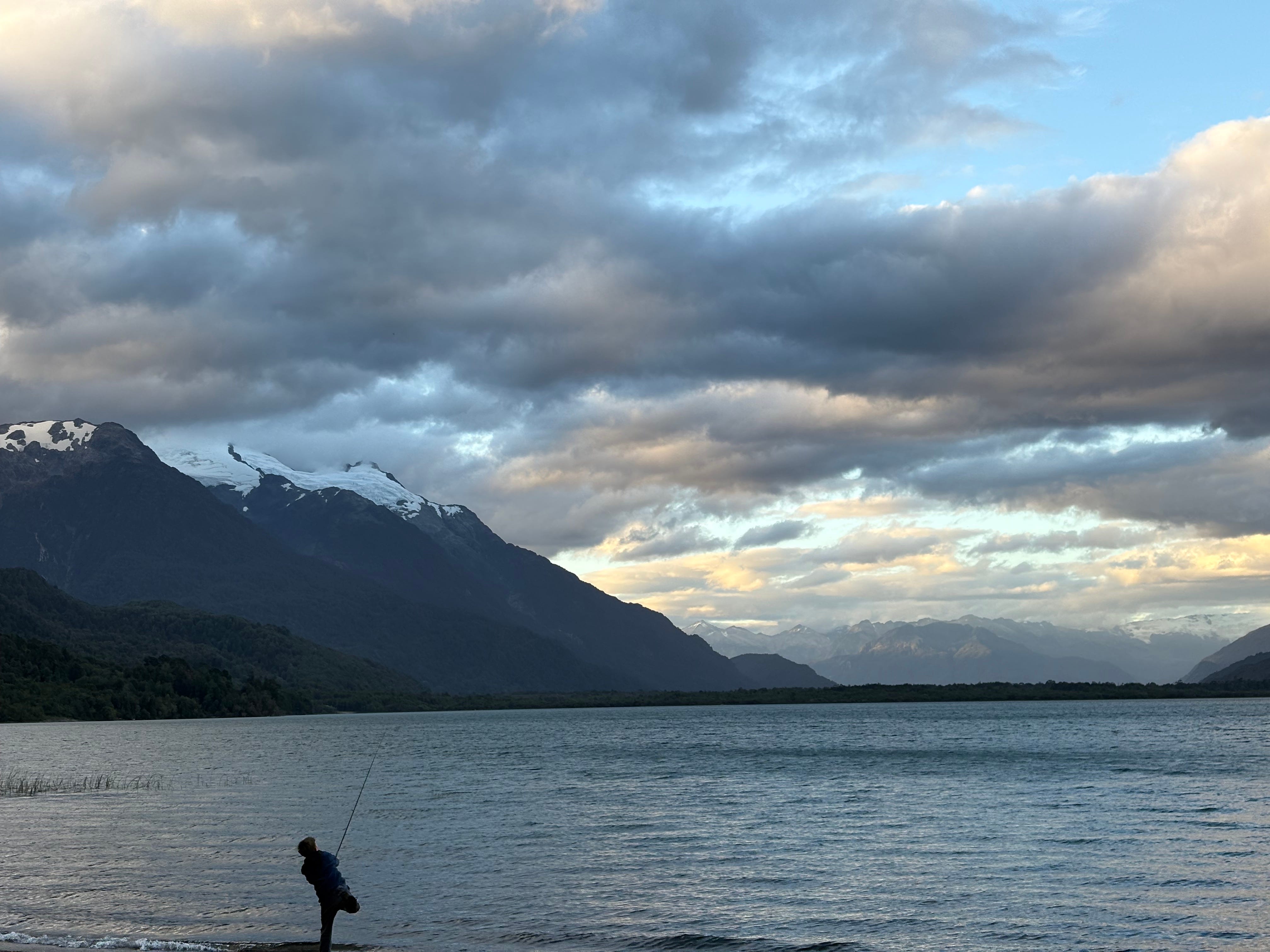
Following a quick resupply in the town of Chaiten, and a fond farewell to Etienne and Coline, we pushed on through Douglas Tompkins National Park to our camp spot at Lago Yelcho. It was here that Poy’s influence on the modus operandi really started to show; a beer at the neighbouring ranch turned into a bottle of wine, which in turn led to a roaring campfire while we ate dinner. We read about the legacy of the late Douglas Tompkins, the founder of the outdoor brand the North Face, who used his personal fortune to buy and protect vast wilderness areas in Patagonia, which he later gifted to Chile and Argentina in one of the largest private land donations in history. The sight of our first glaciers on the peaks across the far side of the lake sent us to bed feeling like we were finally buckling down to Patagonia proper.


Extra curricular activities
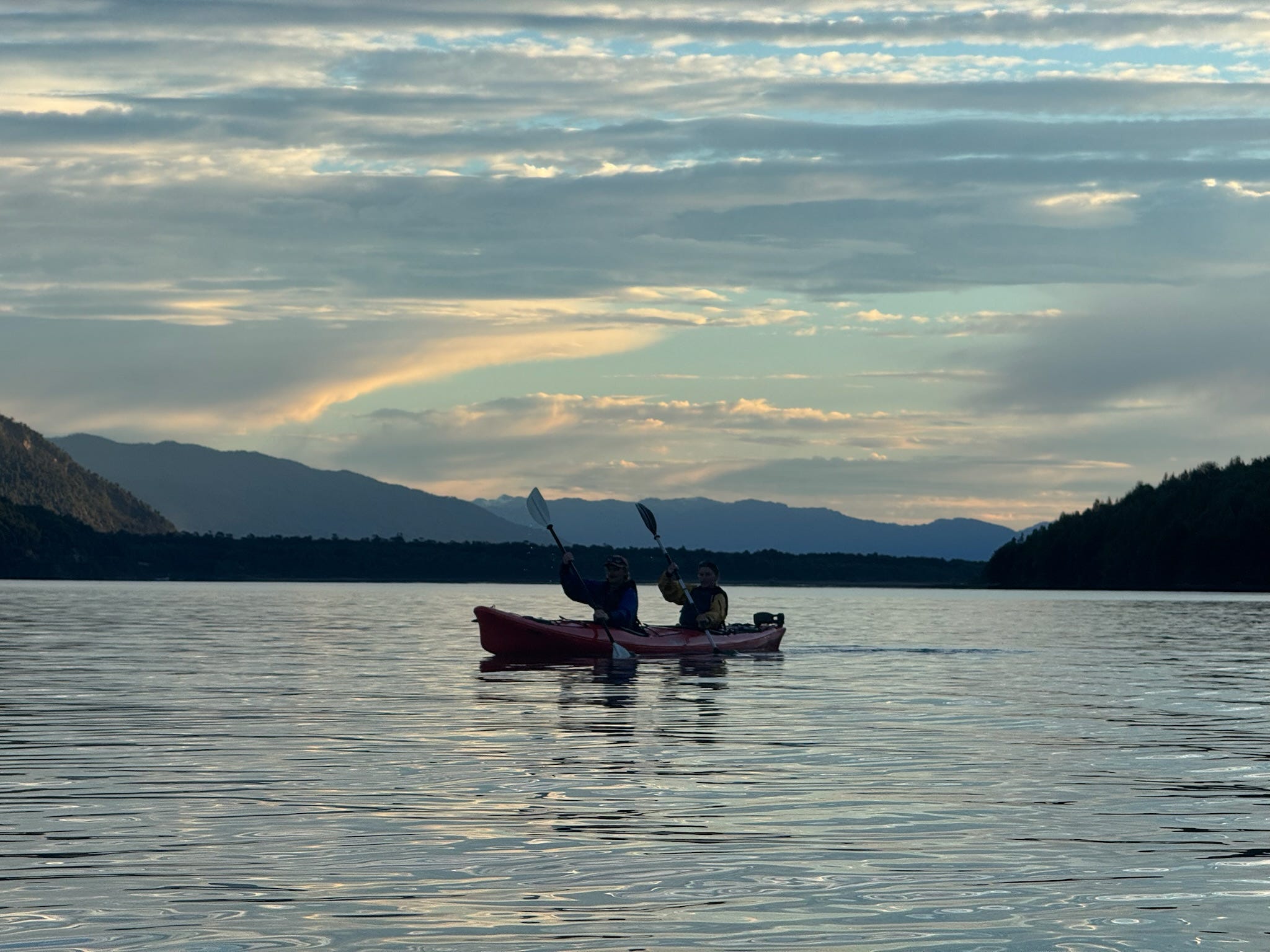
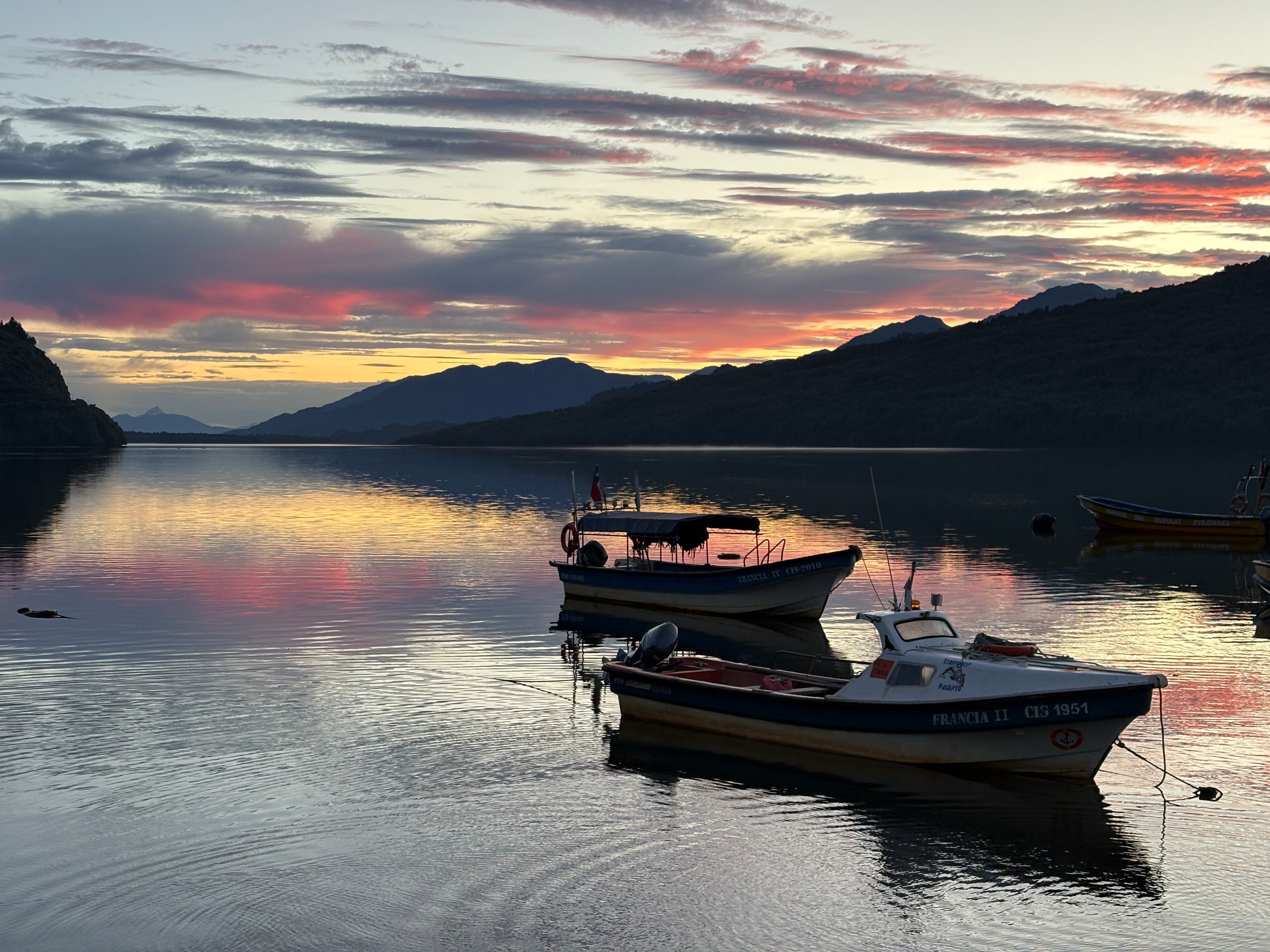
For much of our trip down the Americas, non bike activities have been on the back burner due to time, logistical, or body fatigue constraints. However, it had always been the plan to indulge on that front in Patagonia. This is where the things that excited us the most were, this is where we wanted to invest our time. In the shoreside town of Puyuhapi, we cashed in our first coupon; an evening sea kayak up the fjord to a beautiful waterfall tucked up in the jungle. Extra curricular was off to a good start.
Queulat National Park
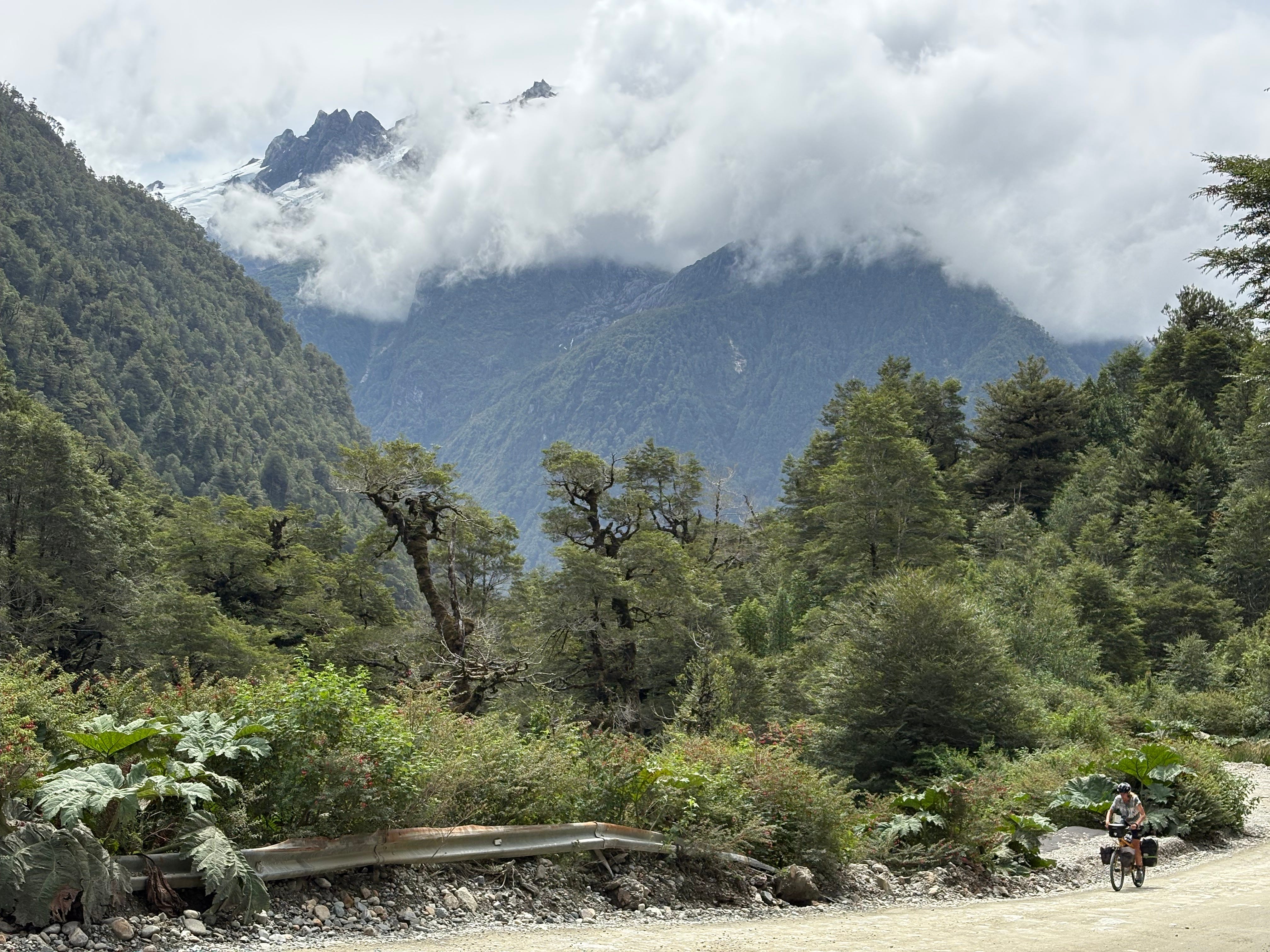
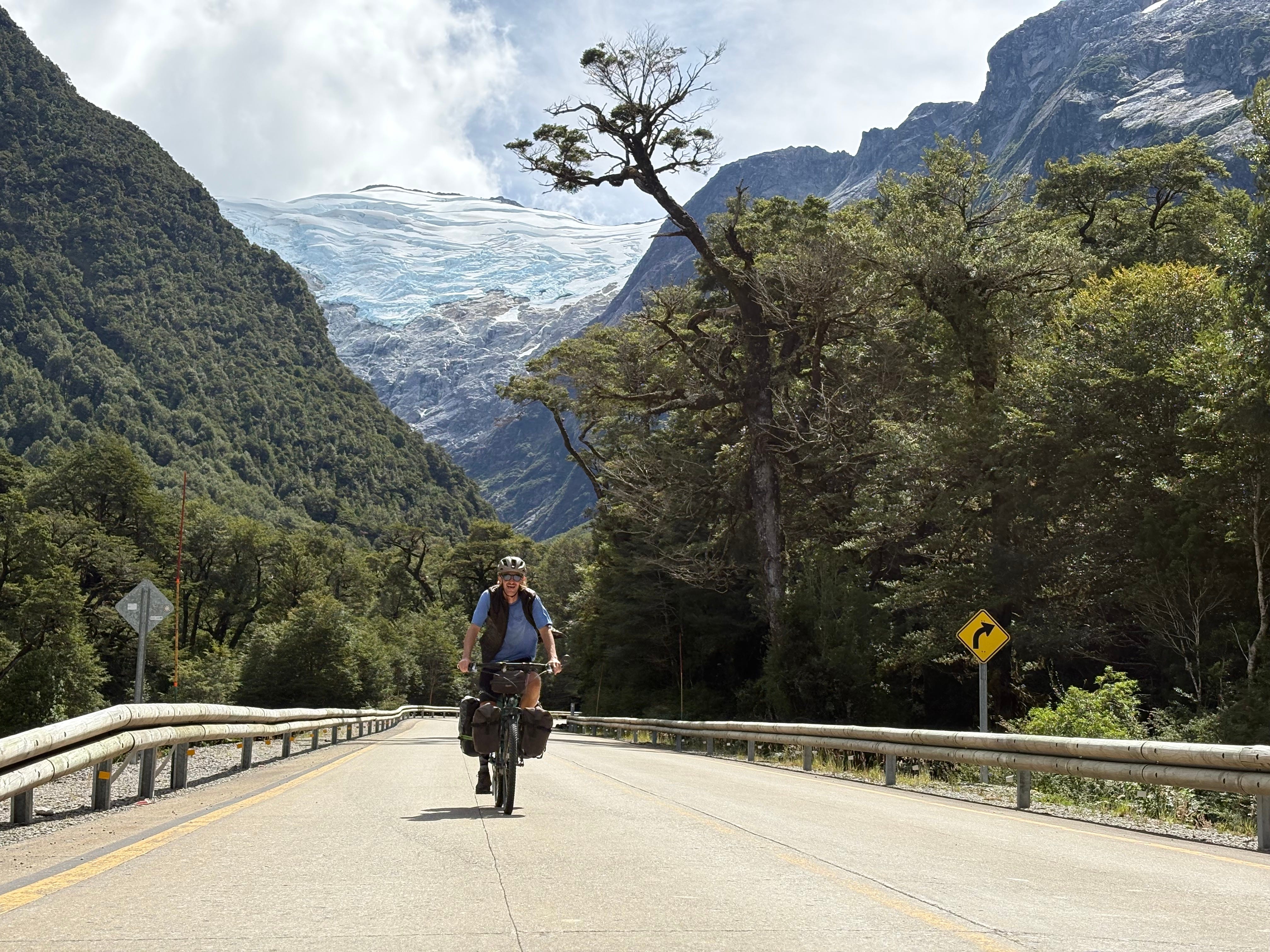
From Puyuhapi we had our first proper cycling test (barring the 10km ferry time trial) of the stint; a gravel climb up through the Queulat National Park; a stunning area of dense rainforest sitting beneath snow capped peaks and hanging glaciers. The climb was brutal, not helped by the constant clouds of dust kicked up by cars and motorbikes as they roared past. As we topped out and began the descent, the road returned to tarmac and we were treated to an incredible view of the Queulat glacier spilling over the side of the mountain. With big rain due overnight, we ducked into a well placed riverside campsite with even better placed shelters.


Moving house (again)
As the big rain kicked in, and we settled into our sleeping bags, disaster stuck; our beloved Terra Nova was leaking, with water coming in from all four corners. We quickly relocated under the cover of the shelter, and went to sleep coming to terms with the fact that the tent that had taken us through so much, was very much not going to take us to Ushuaia. Fortunately, we were a couple of days riding from Coyhaique, the capital of the Aysen region and the biggest town on the Carretera, where we were confident we would be able to find a replacement. For the third time in year, we would be moving house. Complicated business this bike touring.
Wintery mix
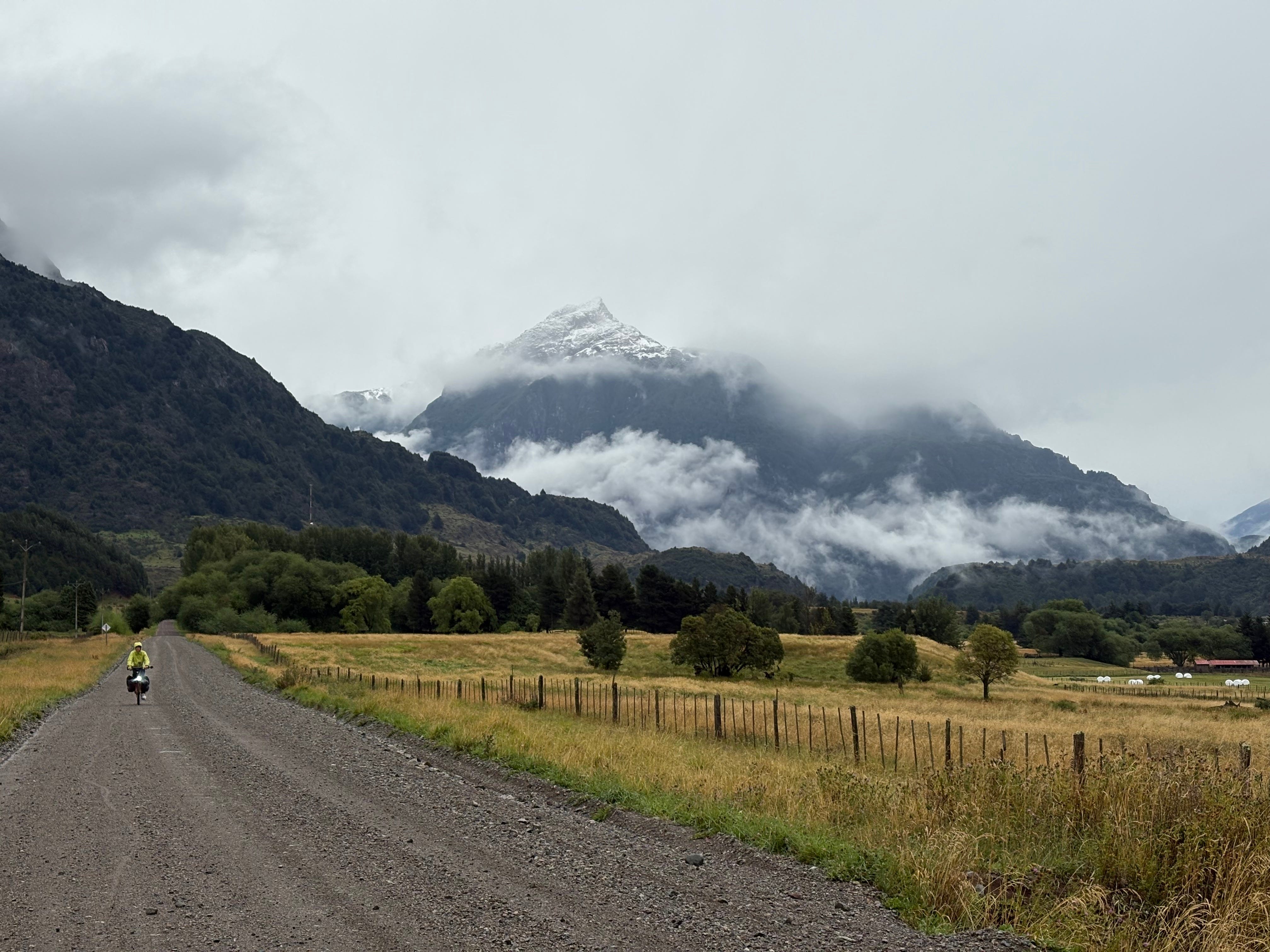
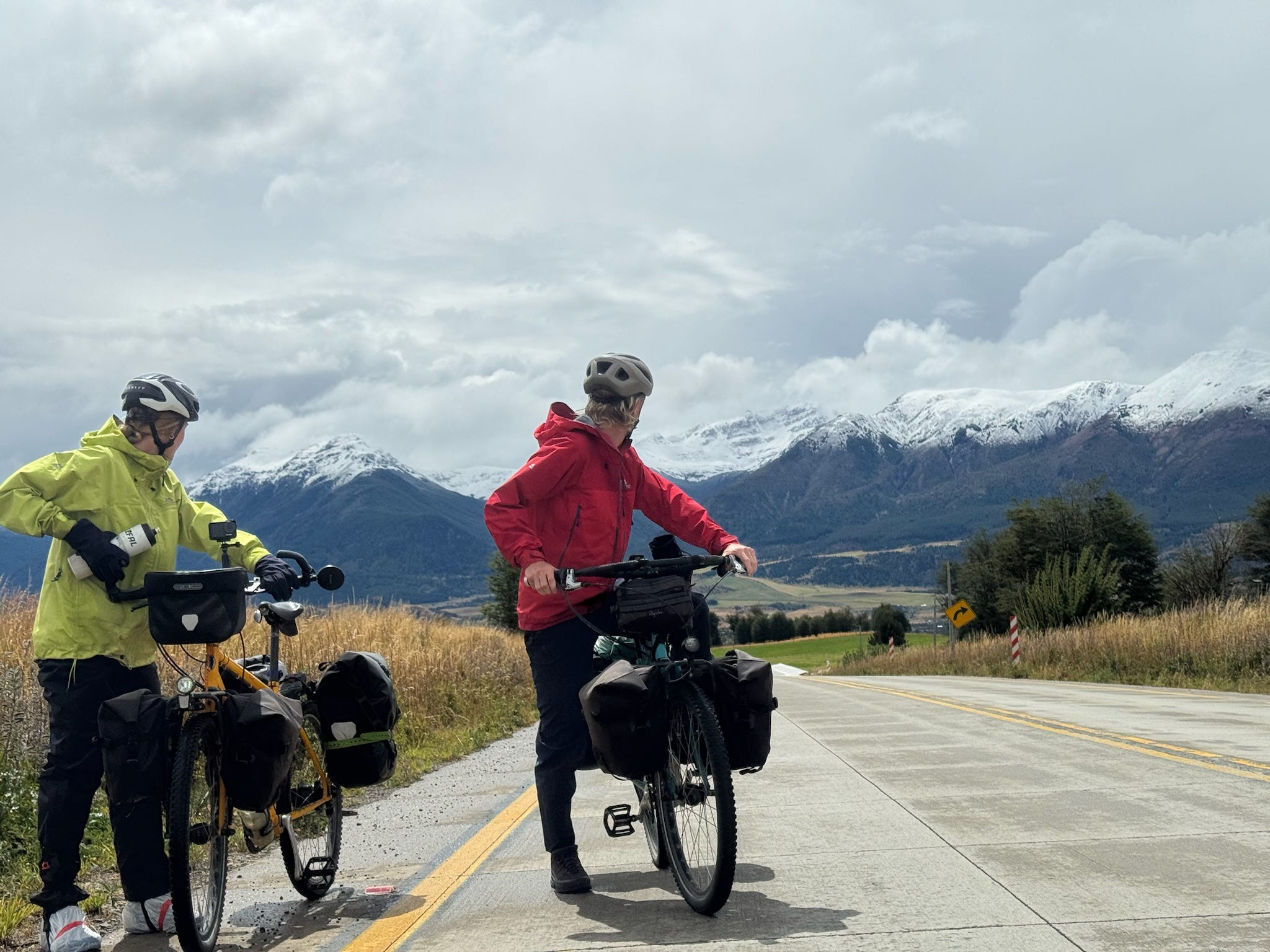
After the previous night’s drama (which somehow, Poy had slept soundly through), we had an easy and uneventful day to Villa Manihuales where we rested up for the big day that was to come. Between us and Coyhaique stood a big dirty gravel climb, through what the forecast promised would be ‘wintery mix’ - which turned out to be a catch all term for rain, snow and sleet. Despite the frigid conditions, it was a beautiful ride surrounded by peaks with a fresh dusting of midsummer snow. Mol, as she so often does, had expertly found us a perfect Cabana on the outskirts of town complete with a log burner and panoramic views over the mountains. We tucked into the two bottles of red that we had had the foresight to carry with us over the gravel pass (there’s that Poy influence again), all feeling ready for a couple of planned rest days - our first since we had left Puerto Varas 11 days previous.
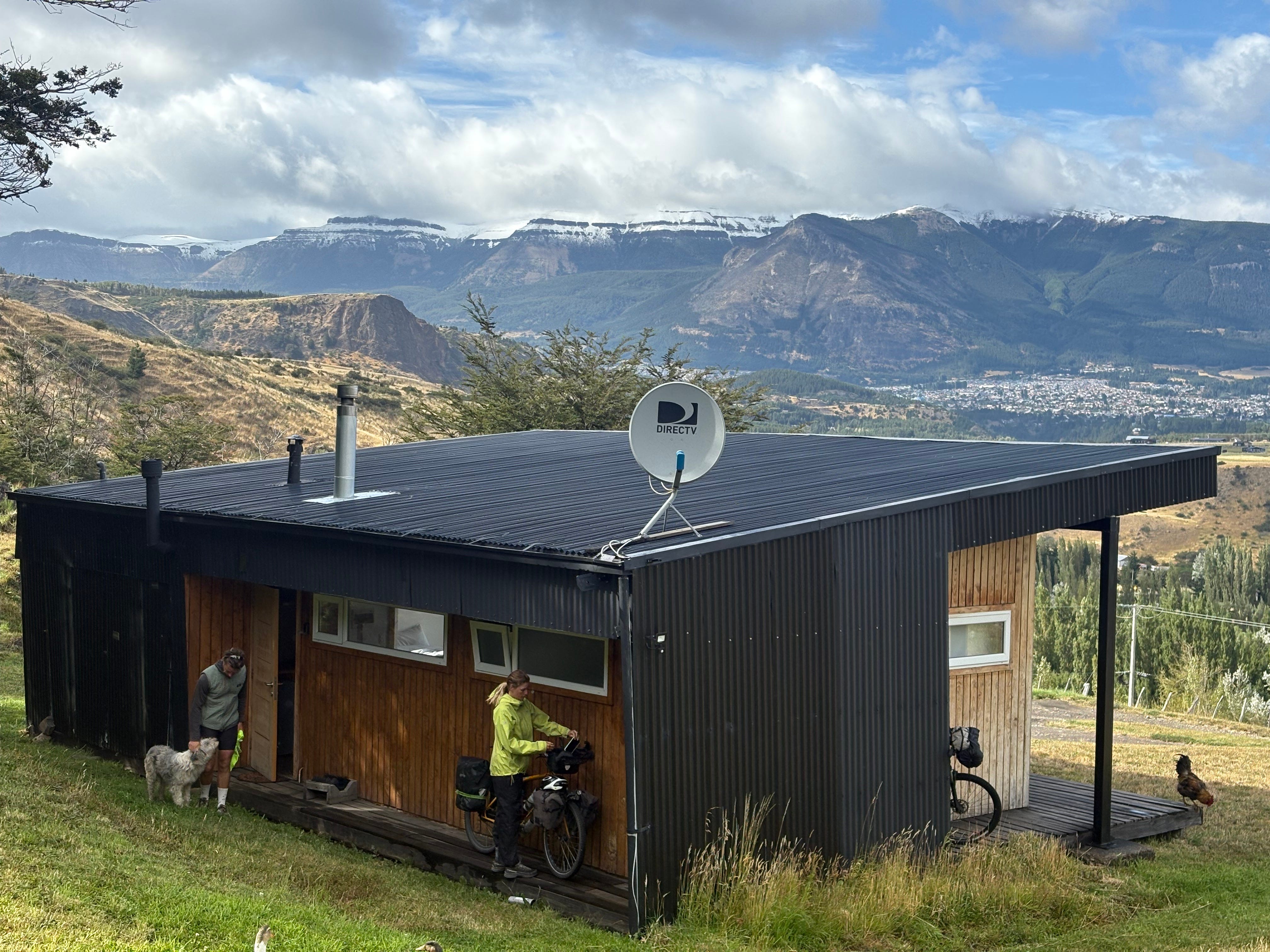
Extra curricular, level 100
The following day we cruised down into Coyhaique, and headed straight for the North Face shop where we picked up the one tent they had in stock - the Stormbreaker 2. Chores complete, we soaked in the lively atmosphere of town and readied ourselves for the second non cycling activity of the stint; rock climbing.
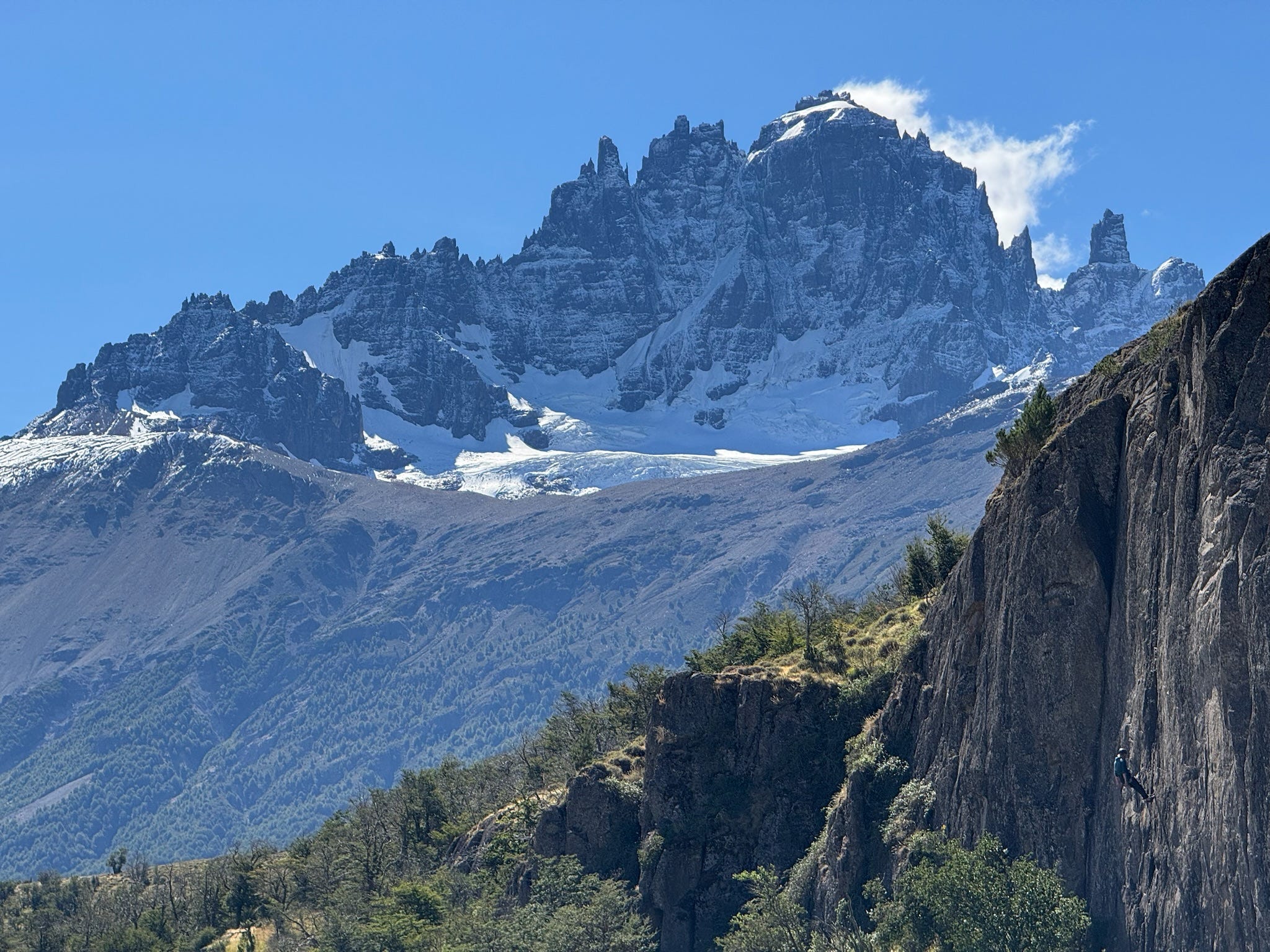
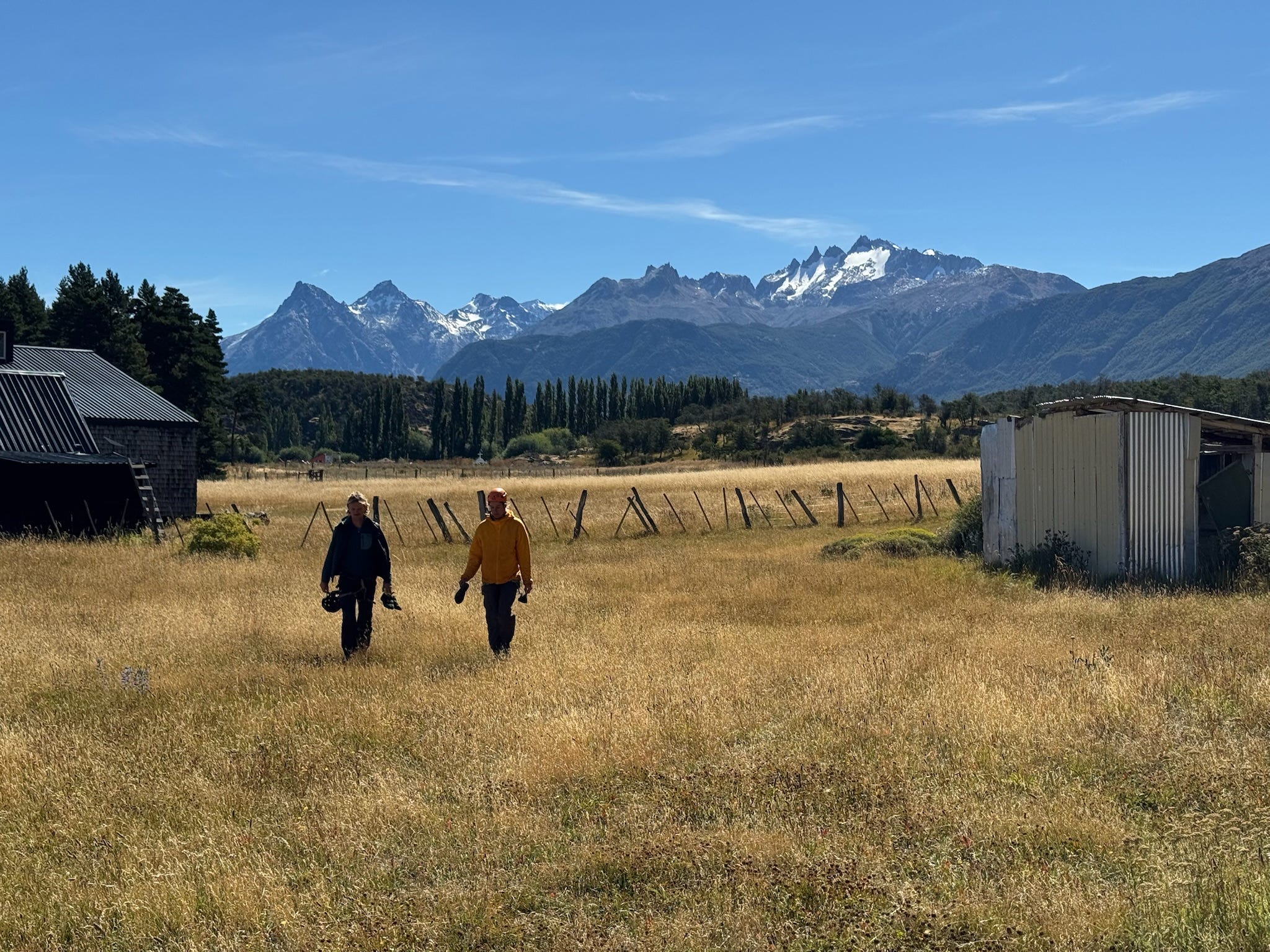
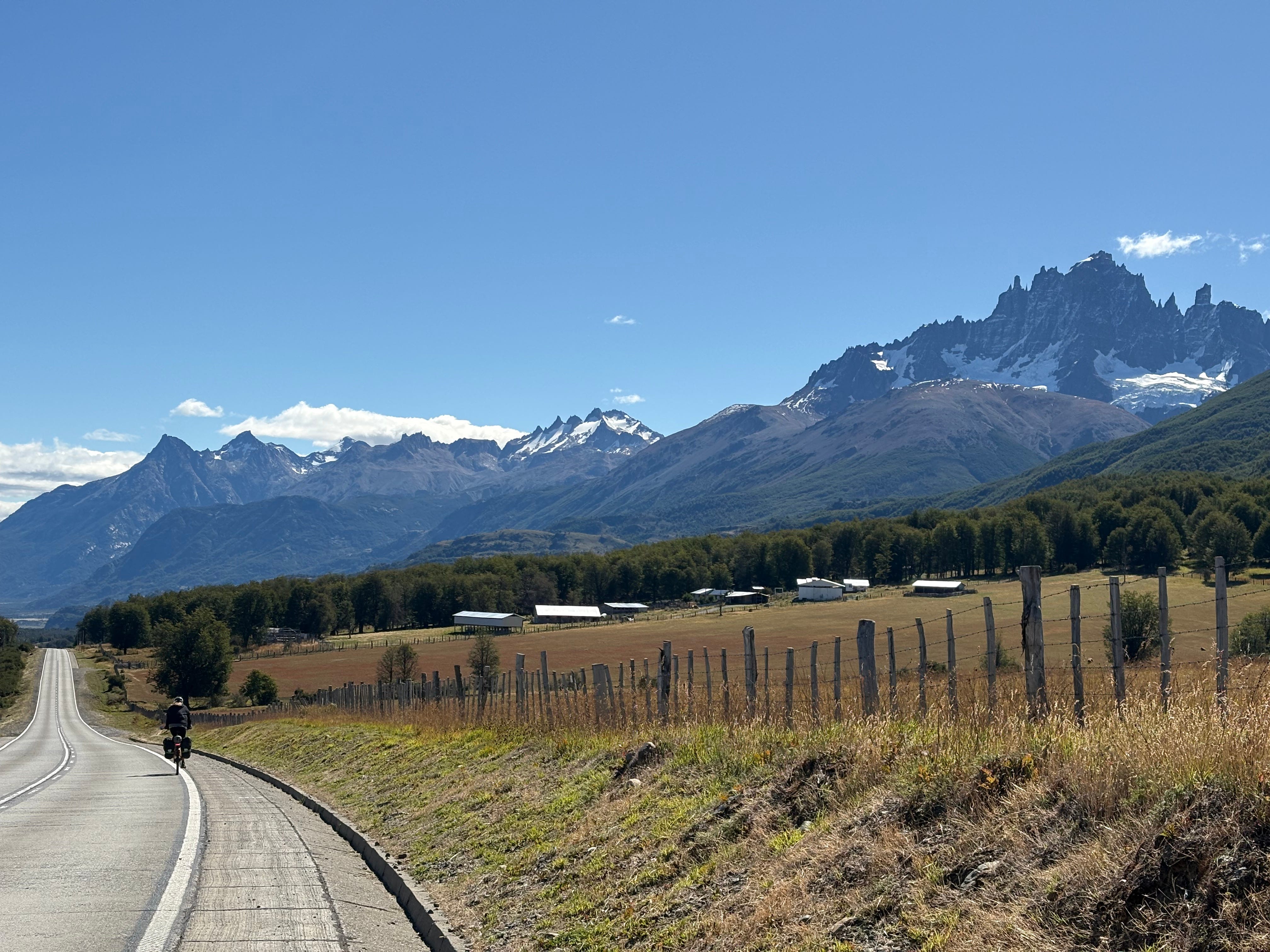
We were picked up by our guide Natalia at 9am sharp and drove in beautiful sunshine over the pass to Villa Cerro Castillo; a little sneak preview of what we would be cycling in a couple of days time. We met up with another couple of guides, and spent an incredible day climbing easy routes (which were still too hard for us) under the shadow of Cerro Castillo - an amazing mountain that towers over the valley, making you wonder what all the fuss about Fitzroy is about. Despite the fact that 10 months of cycling has left our already pitiful upper body strength in an even more pathetic state, it was a wicked day.
Mechanical
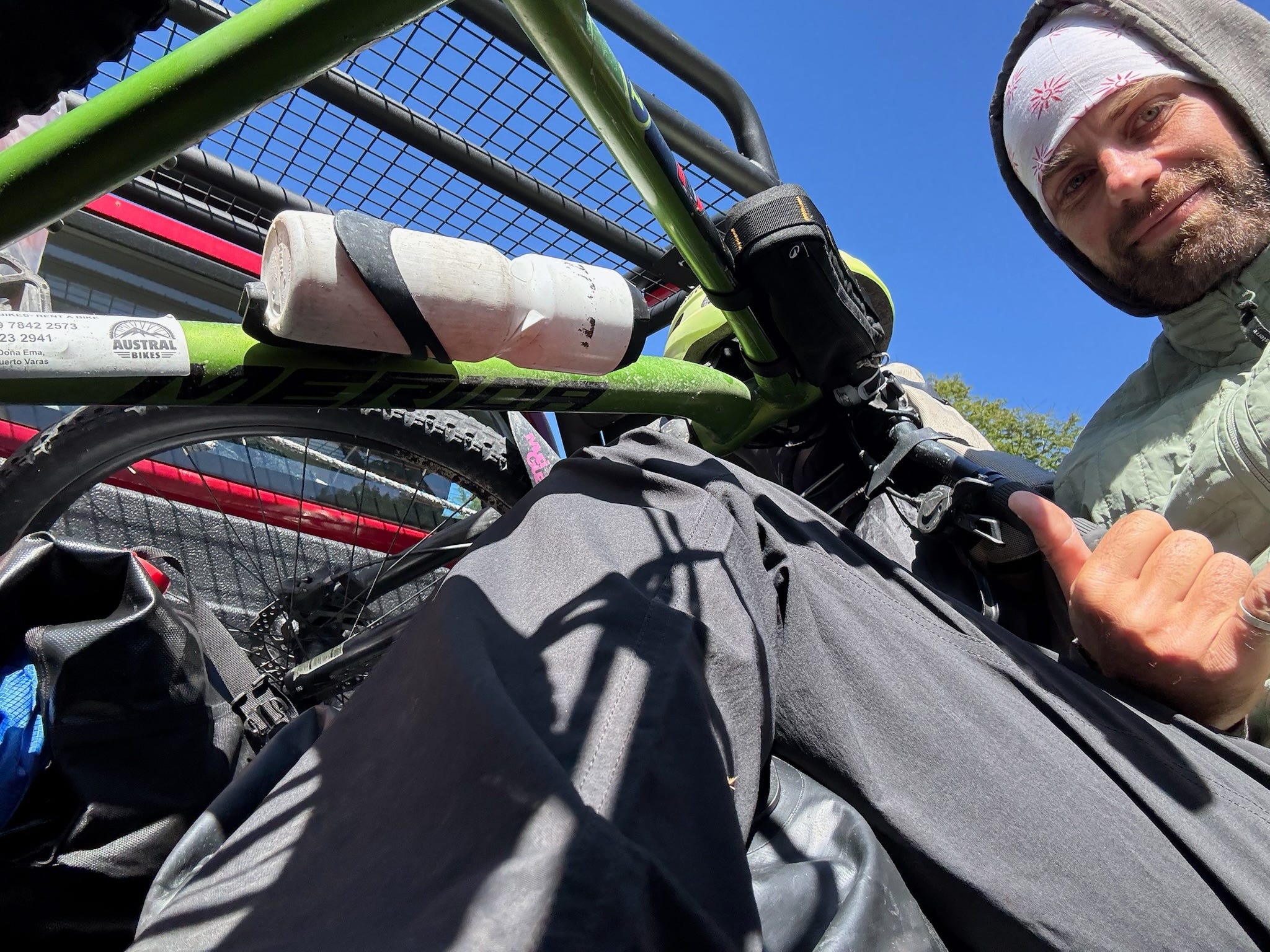
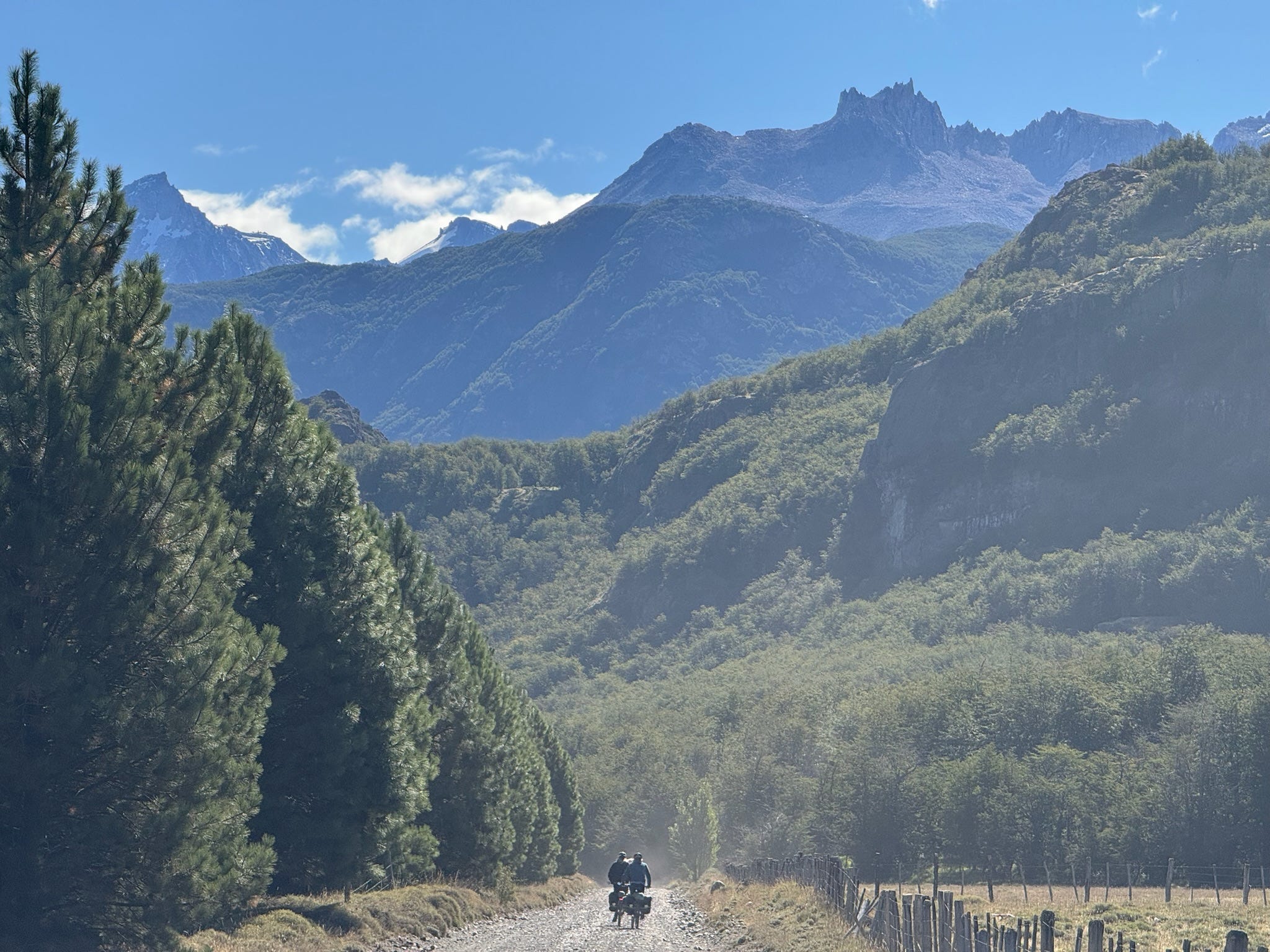
Distance wise, Coyhaique sits a little over halfway through the Carretera; however, whilst the northern half is largely paved, the southern half is largely not. We knew from our climbing excursion that we had tarmac to Villa Cerro Castillo, but from that point onward it was going to be goodbye smooth surfaces, hello ripio. We set off in high spirits, with tailwinds and sunshine, excited to get stuck into the wild. 30km in, disaster stuck - two of the spokes on Poy’s rear wheel snapped. Downside: not really rideable, especially with a heavily loaded bike. Upside: part of the service from Austral Bikes is access to mechanics dotted along the route, and it looked like there was one in Villa Cerro Castillo. We agreed a rendezvous point in town, and left him stood on the side of the road with his thumb out. 2 minutes later, he whizzed past us in the back of a pickup truck. Hitch hiking, piece of cake.
Hikin
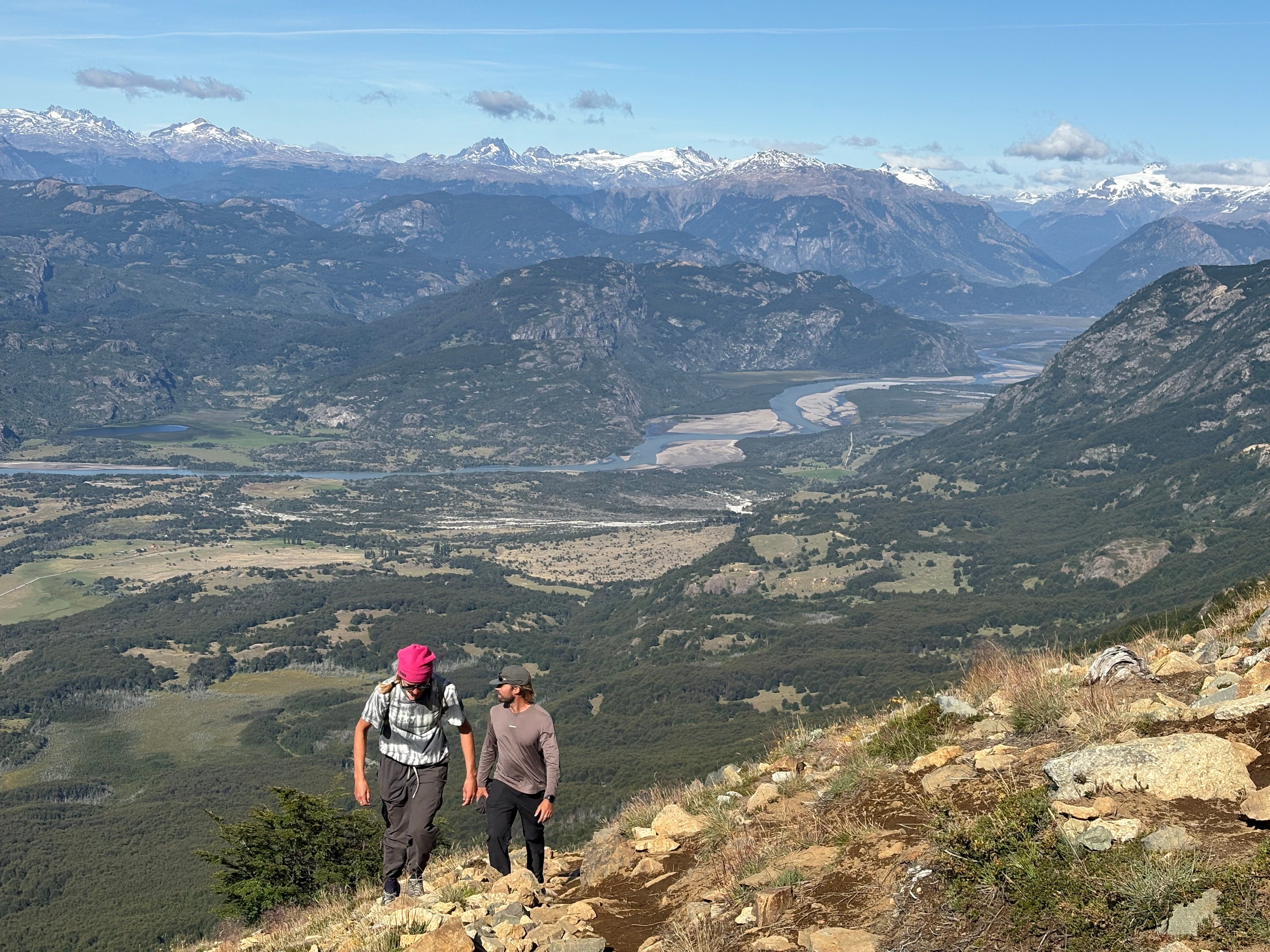
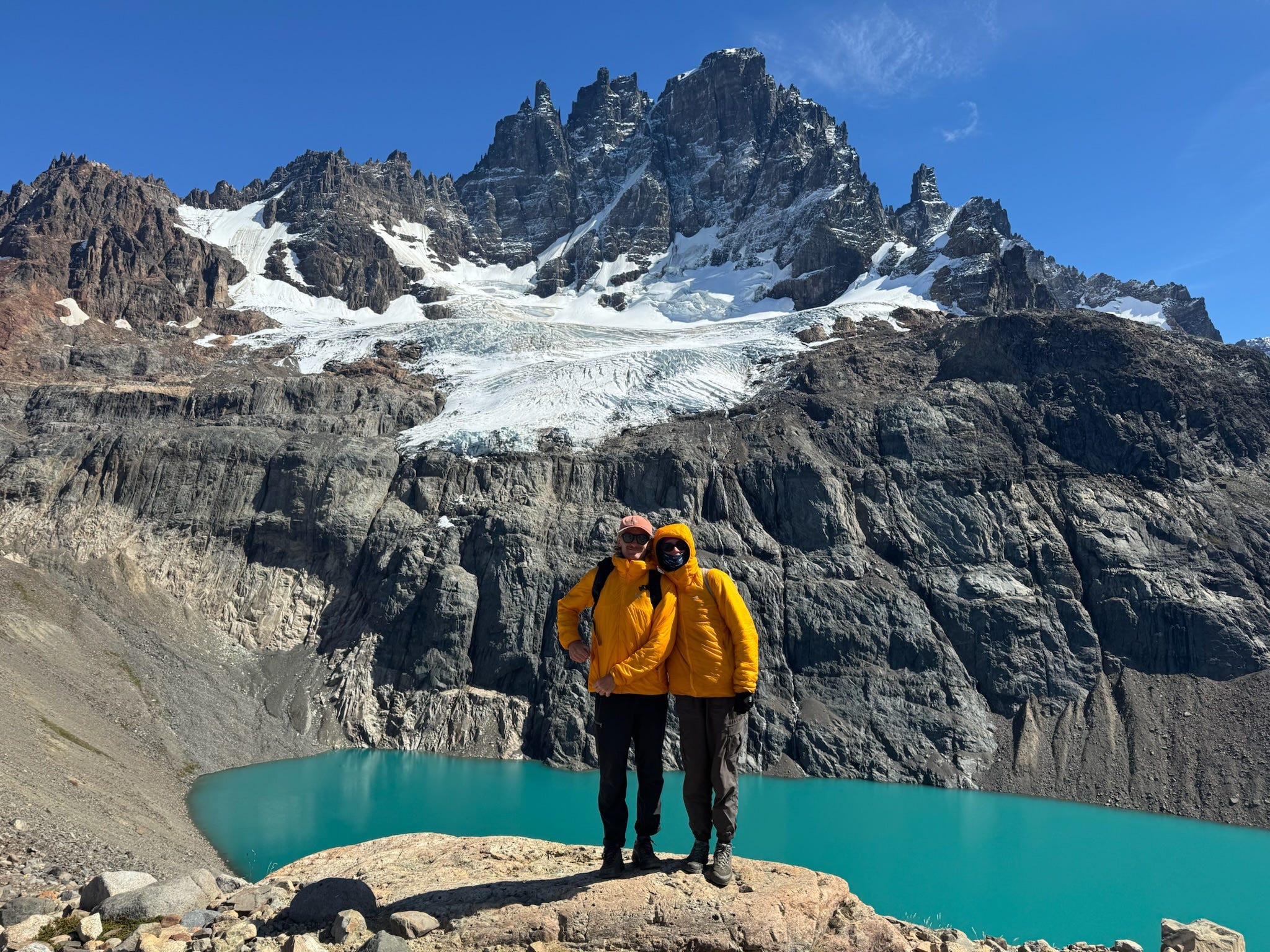
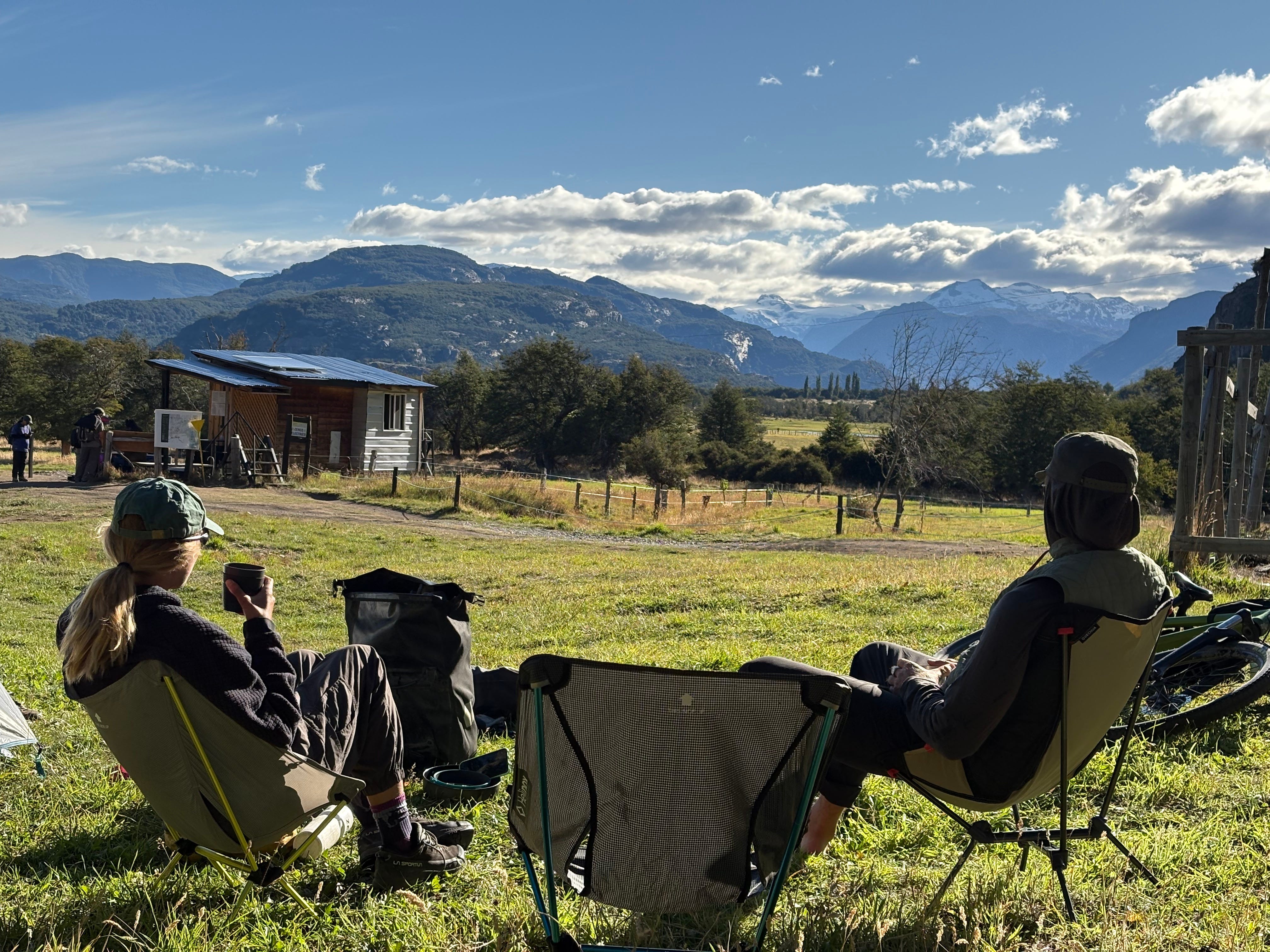
When it comes to hiking in Patagonia, Torres del Paine and Fitzroy are far and away the most popular places to get out on the trails. We will be heading through both later on the trip so I guess we will find out, but it’s almost impossible to imagine that they can be more beautiful that Cerro Castillo. Having ridden (or in Poy’s case, walked) 5km down a gravel track to a small campsite at the park entrance, we took a day off to do a hike up to the laguna that sits at the base of ‘Castle Hill’. Wow.
Rebalancing
Unfortunately, the mechanic in Villa Cerro Castillo was out of town for a few days, so we hadn’t been able to get Poy’s bike repaired. Back down at camp, we also discovered a crack in his rim - making the repair more complicated that originally anticipated. The ever helpful Austral Bikes said that they could send out a replacement wheel, but only to Rio Traquillo in a couple of days time. Extra unfortunately, Rio Tranquillo was 120km down the road, almost all of which was ripio. It seemed a massive shame for Poy to have to hitch hike such a big section of the route, and for us to have to split up given that the ride would take 2 days. After much deliberation, we decided that as the wheel wouldn’t arrive for a couple of days anyway, he might as well try and ride. We shifted as much weight as possible off his rear pannier, onto his handlebars and our bikes. The new setup survived the stress test of a 20m ride round the campsite. It was all systems go for riding to Rio Tranquillo.
An agricultural night
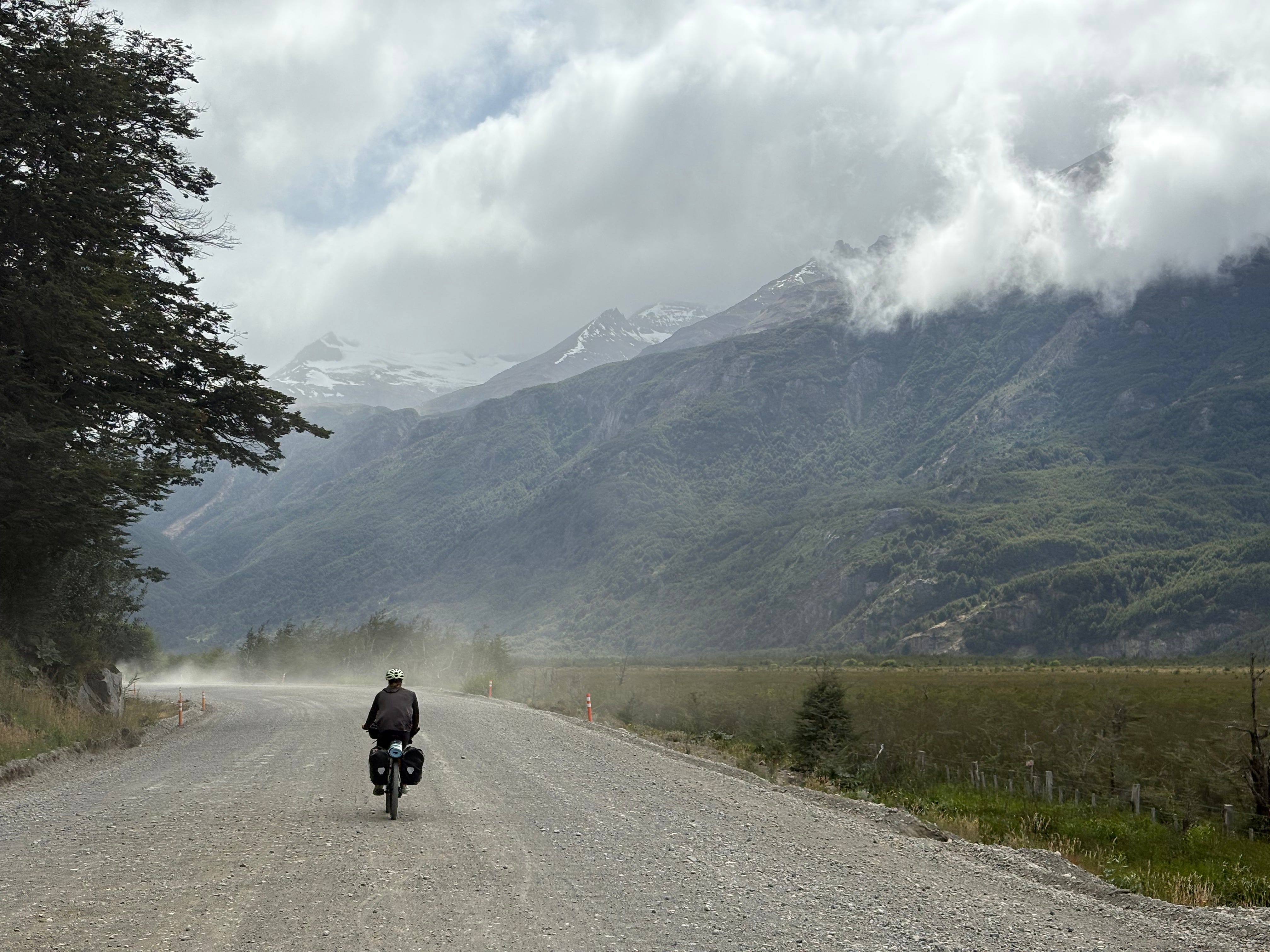
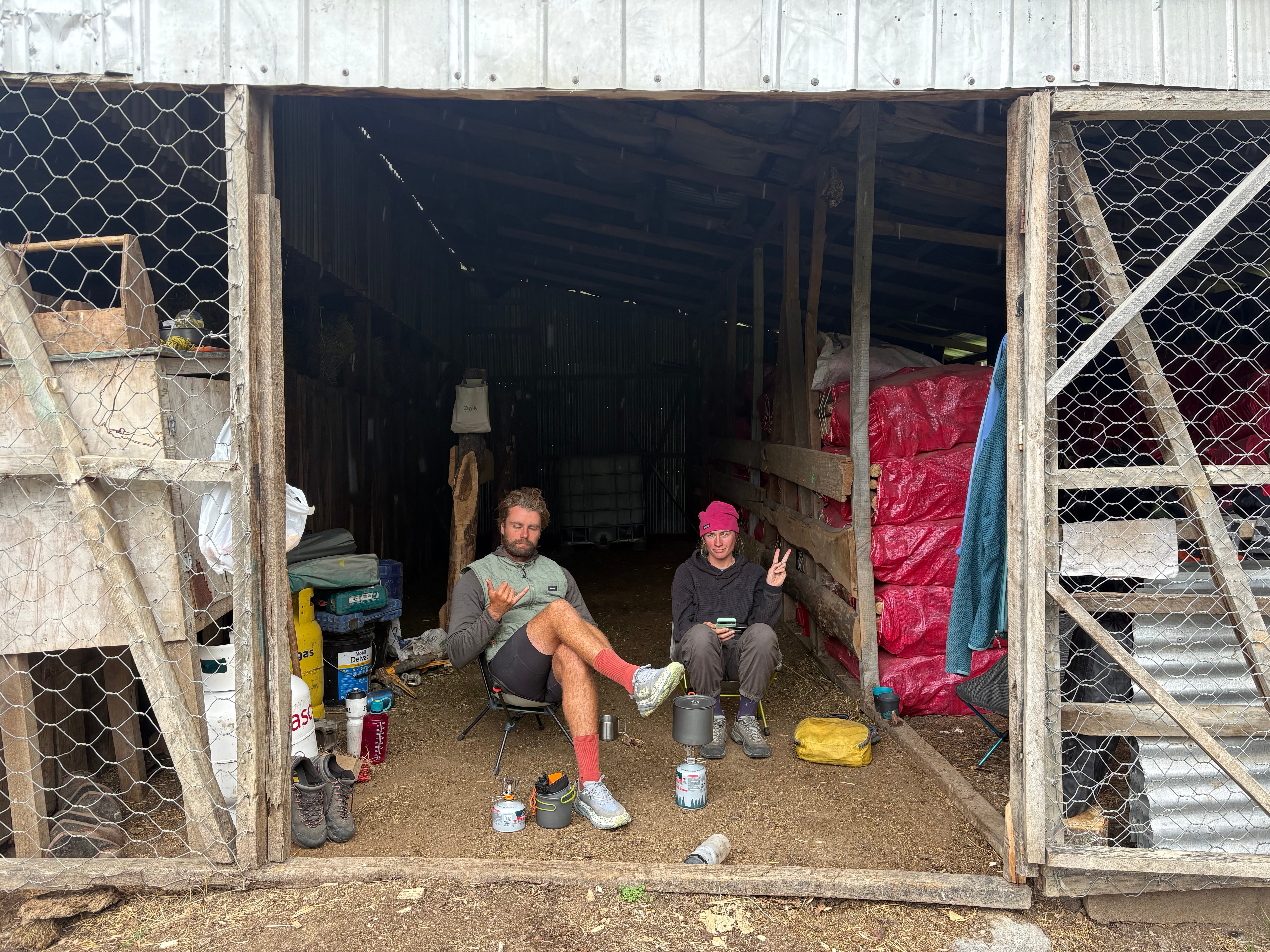
We set off timidly the next morning, keeping a watchful eye on Poy’s enormously buckled, creaking wheel. As bad as it looked, it didn’t seem to be getting worse, and our spirits began to lift as we rode out of town towards the end of the paved part of the Carretera. As we hit the ripo, the spirits were put firmly back in their place. Massive chunks of loose gravel made for slow, tough going, with the ripping headwind funnelling down the valley being the icing on the cake. This was one of the handful of sections where the road heads due west, directly into the prevailing wind. Exactly what you need when you’re nursing a broken bike. With heavy rain due overnight, we decided to call it quits at the only ‘formal’ campsite on this section of the route; which it turned out, was essentially just a farm with a small refuge attached. Which was full. Brilliant. Conscious of the forecast, the kind farmer offered us the barn to pitch our tents under, to stay out of the worst of the rain. We graciously accepted, and once he had swept away the worst of the sheep poo, we settled in to rest up ahead of what would be a big day the next day.
Emotional release
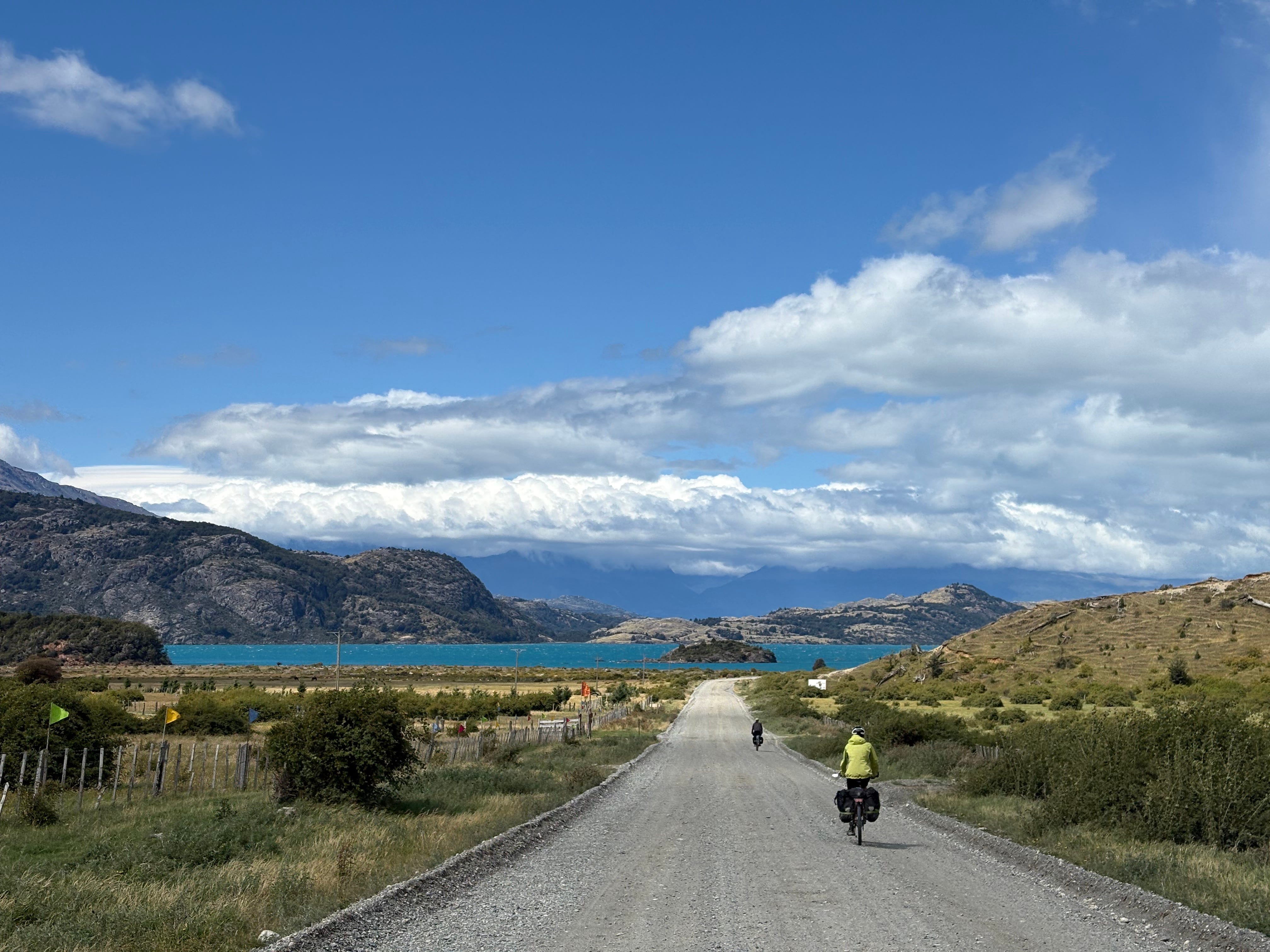
We set off at dawn, with 80km of hilly ripio to cover in the pouring rain. The wheel was holding up, but we knew at any moment it could go and it would be back to hitch hiking for Poy. Finally, we crested the final hill and Lago General Carrera came into view; an enormous lake that straddles Argentina and Chile, which is a shade of blue that makes absolutely no sense. Down in Rio Tranquillo, we took Poy’s bike to the mechanic who had the new wheel waiting. It was a huge emotional release; there had been so much uncertainty hanging over the last few days, and against the odds we had made it.
The North Patagonian Icefield
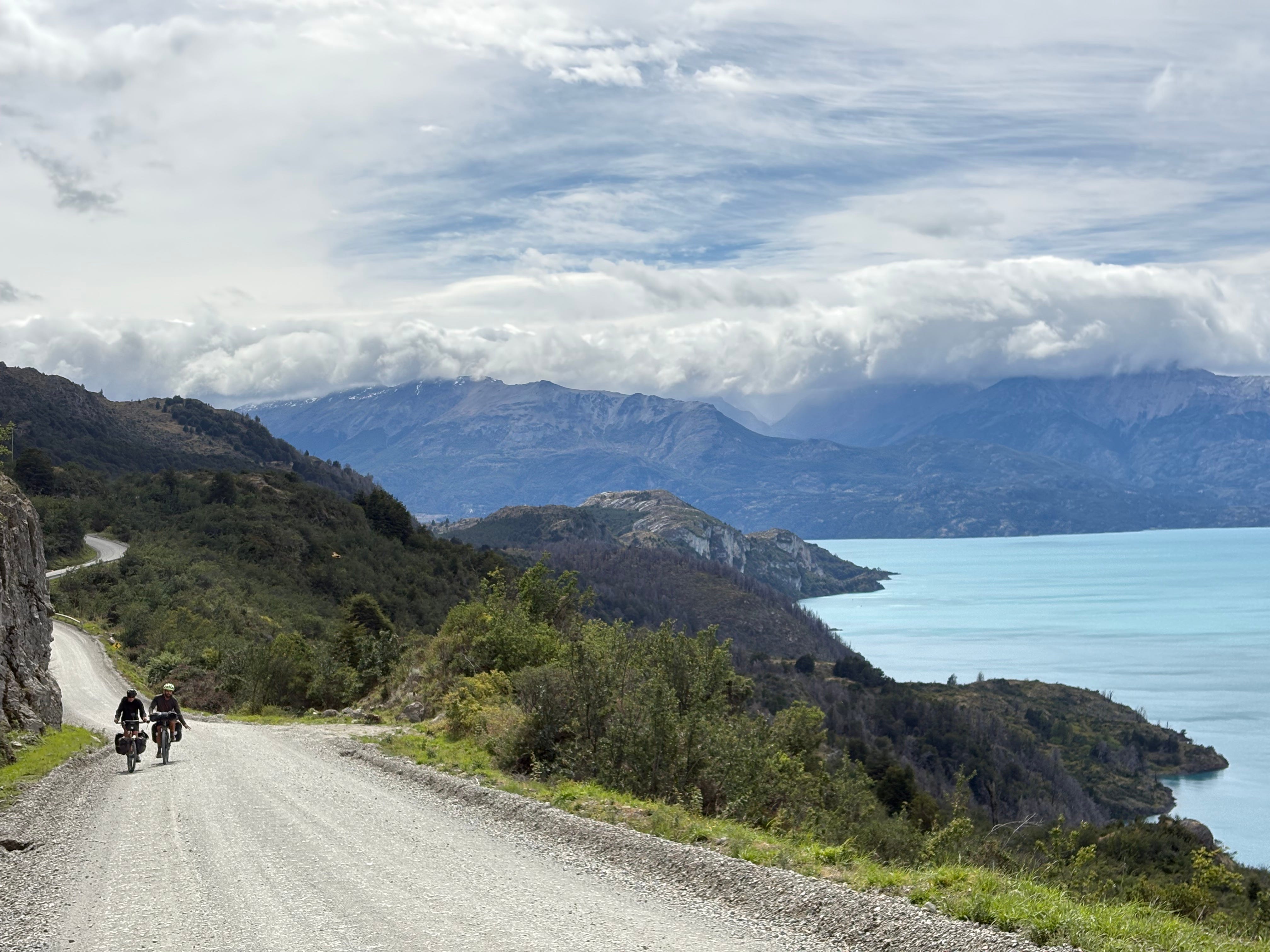
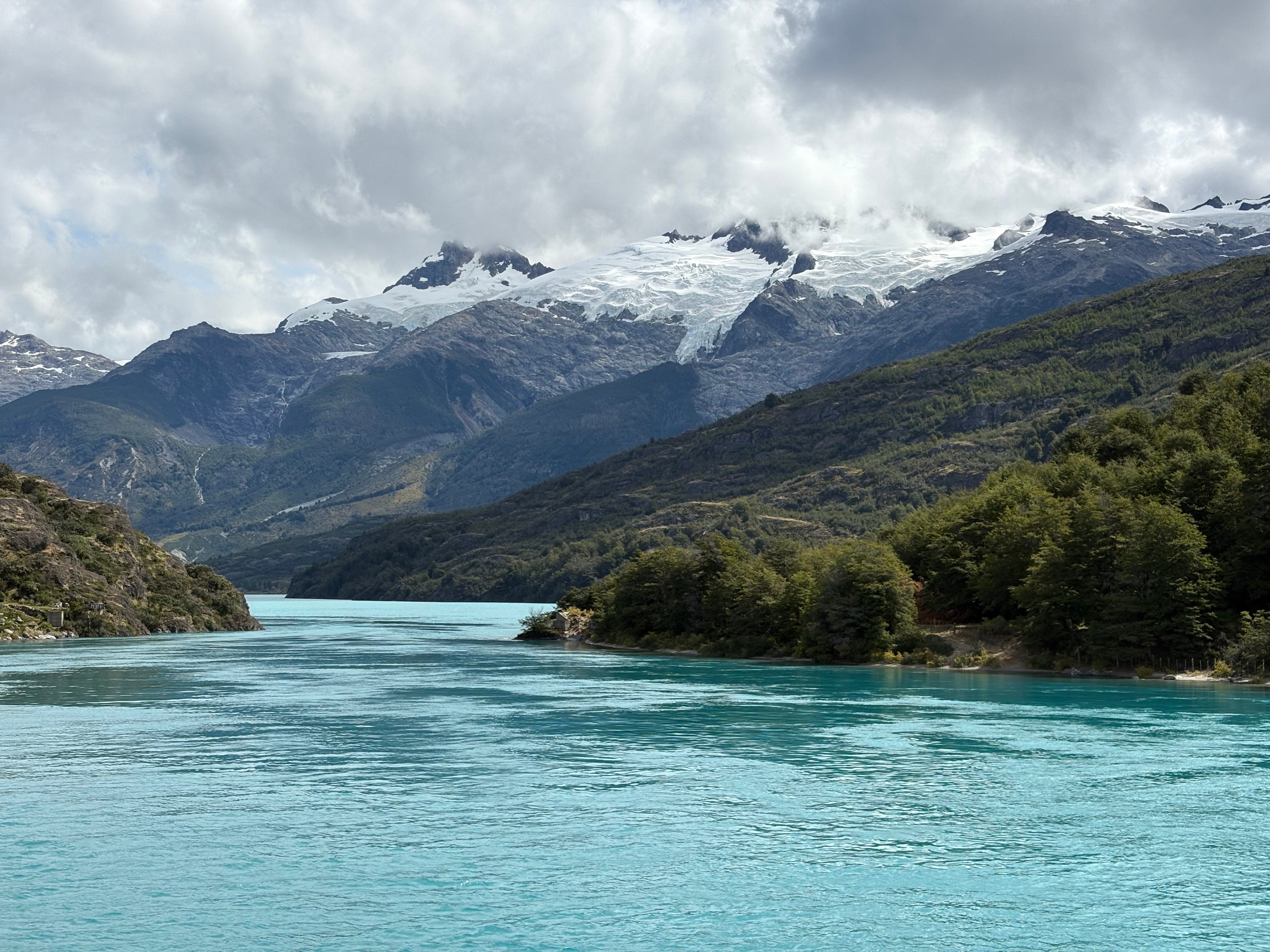
Rio Tranquillo sits at the northeast edge of the North Patagonian Icefield; the second biggest continuous lump of ice outside the polar regions. Riding south from Rio Tranquillo, we began to catch glimpses of the countless exit glaciers that spill over the mountains, providing the mineral rich waters that turn the lakes and rivers into such mind boggling shades of blue. It was straggering, pinch yourself scenery to be riding a bike through.


A special camp spot
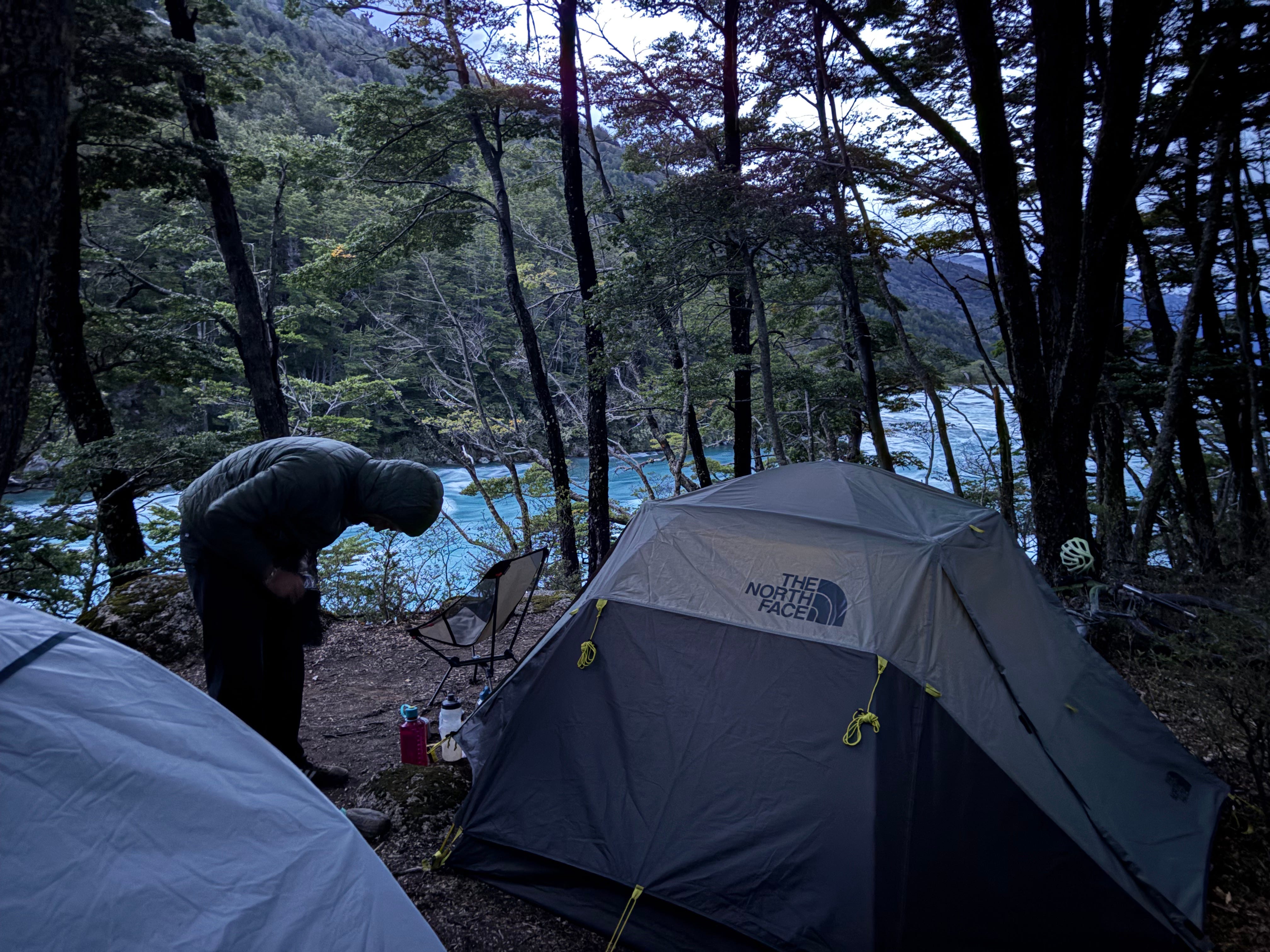
South of Puerto Bertrand on the banks of the Rio Baker, we set up for what was, surprisingly, our first wild camp of the ride down the Carretera. Further north, the density of tourists and abundance of campsites had meant that the opportunities for pitching up in epic roadside spots had been limited. However, we were now past the most southerly road crossing to Argentina, meaning that the road was a dead end; and as a result, the already limited traffic had dropped to almost nothing. It was an absolutely magical place to spend the night, next to the raging torrent of Chile’s most volumous river.


The final pit stop
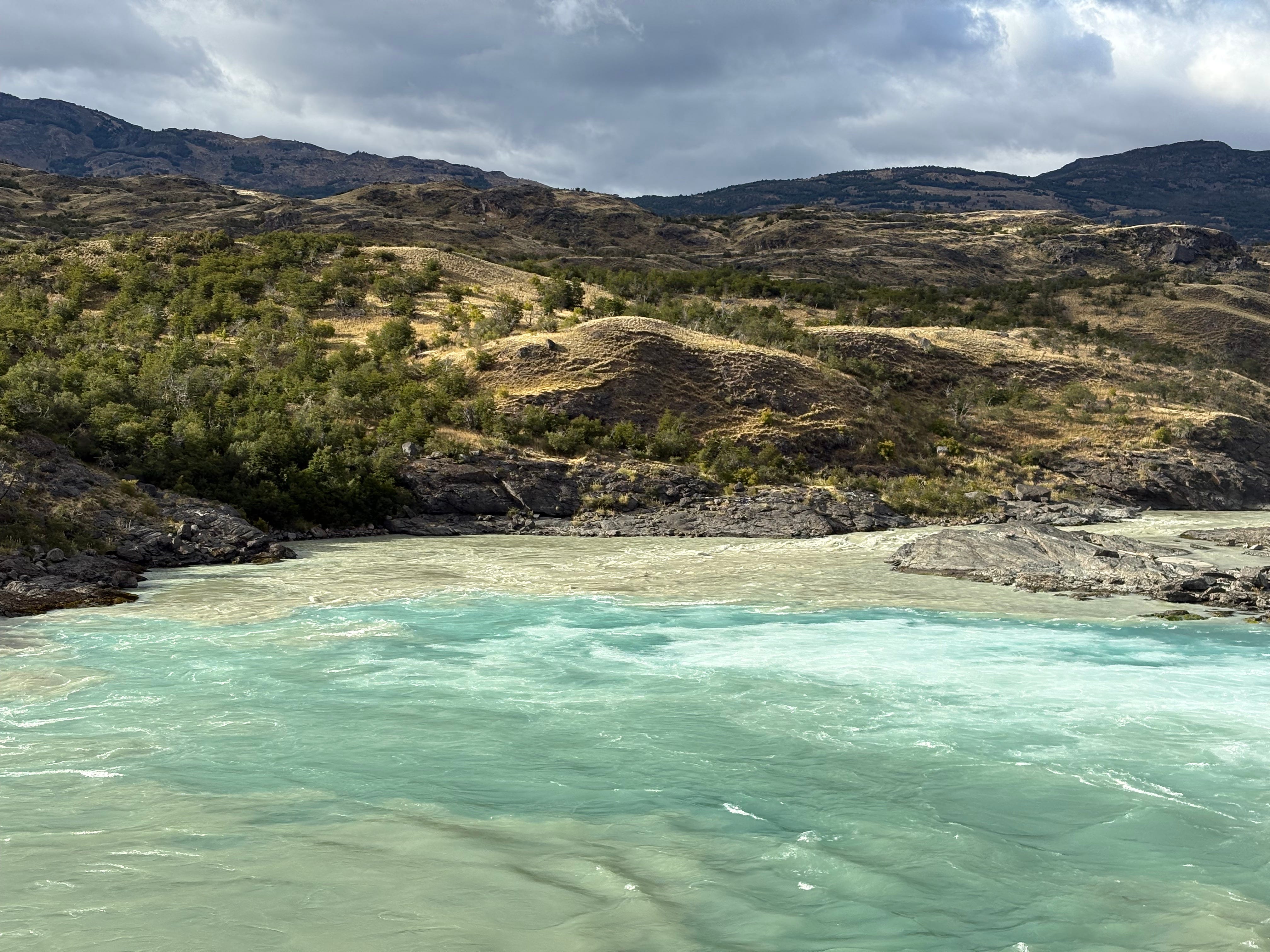
The next morning, we packed up camp and rode south along the banks of the Rio Baker to ‘La Confluencia’; the point where the bright blue waters of the Baker meet the cool grey of the Rio Neff. After a short break gawping at the roaring, swirling torrent, we continued on up through a canyon and along the edge of Patagonia National Park - one of Chile’s newest, again owning it’s formation to good old Dougie Tompkins. Eventually the ripio turned to tarmac and we found ourselves entering Cochrane, the final town on the Carretera before Villa O’Higgins. The end was starting to creep into view.


Extra curricular hat-trick
The one thing Poy had been desperate to do coming down to Patagonia was fly fishing. Unbeknownst to us, it is the undisputed nirvana for trout and salmon fishing, drawing people from all over the world. Any doubt we had had about it was put to rest when Natalia, our climbing guide, had casually slipped into conversation that the previous evening she had had dinner with Yvon Chouinard - the founder of the clothing brand Patagonia - who was down in Coyhaique for his annual fly fishing trip. If it’s good enough for Yvon, it’s good enough for us.
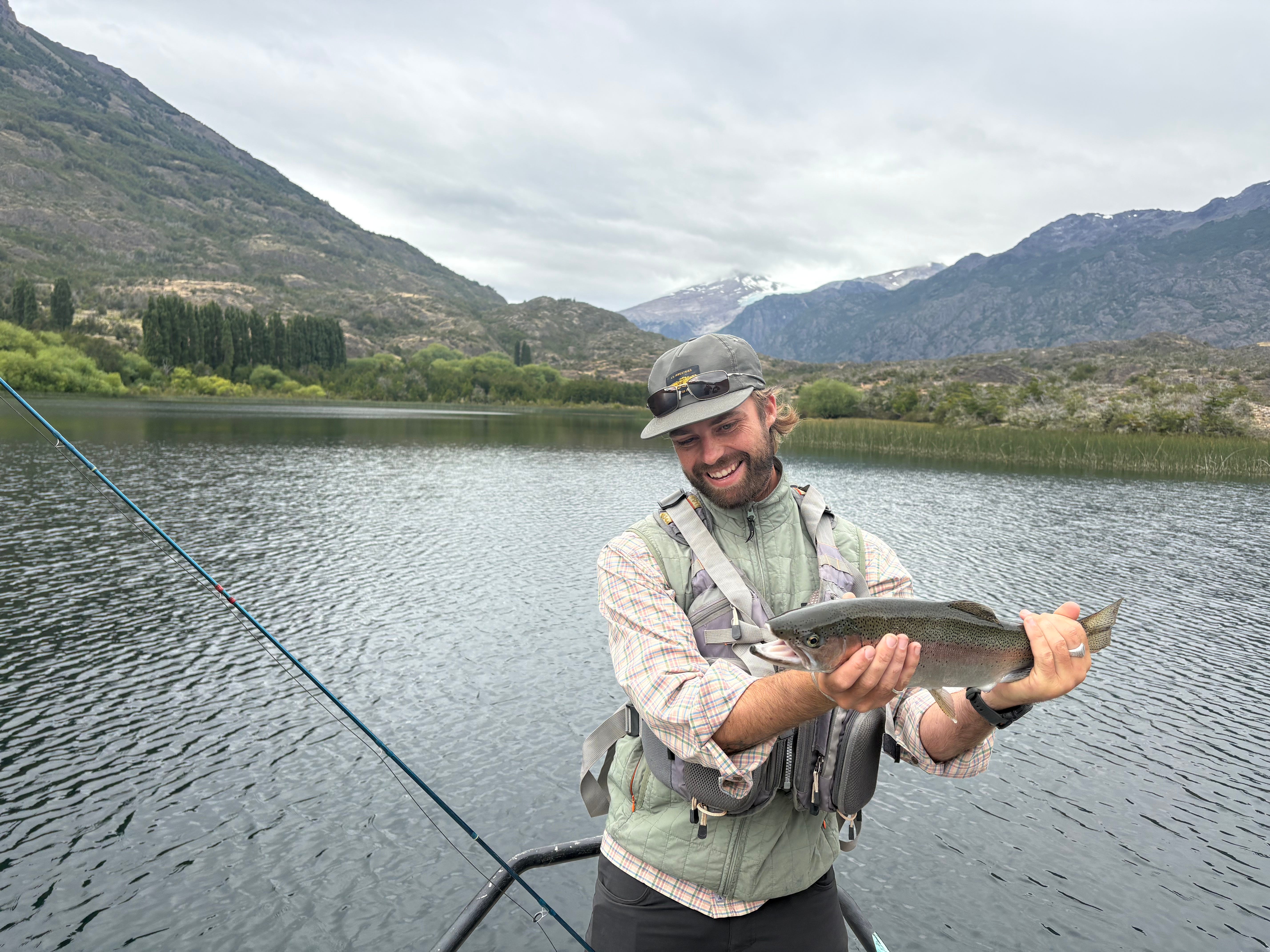
We spent a ‘rest’ day in Cochrane chasing a bite with a wonderful guide Christian, who under the banner of Dunkler Fishing took us for a morning at a mountain lake and an afternoon on the river, with a quick trip to an unbelievable glacier viewpoint in between. Unfortunately, the 10 minutes of on land technique practice was obviously insufficient for Cam and Mol, who caught absolutely zilch. Thankfully Poy was on hand to save the day, landing a healthily sized trout for a quick snap before putting it back. More work to be done before we can abandon the pasta and tomatoes to live off the land, but it was a cracking day out.


A wild finale
From Cochrane to Villa O’Higgins, there is nothing. Well, pretty much nothing, save the small ferry port of Puerto Yungay where yep, you guessed it, the Carretera dead ends and is replaced with a boat ride across a fjord. We planned to ride it over 4 days, meaning 3 nights of wild camping and as a result 3 bikes heavily laden with food riding out of town.
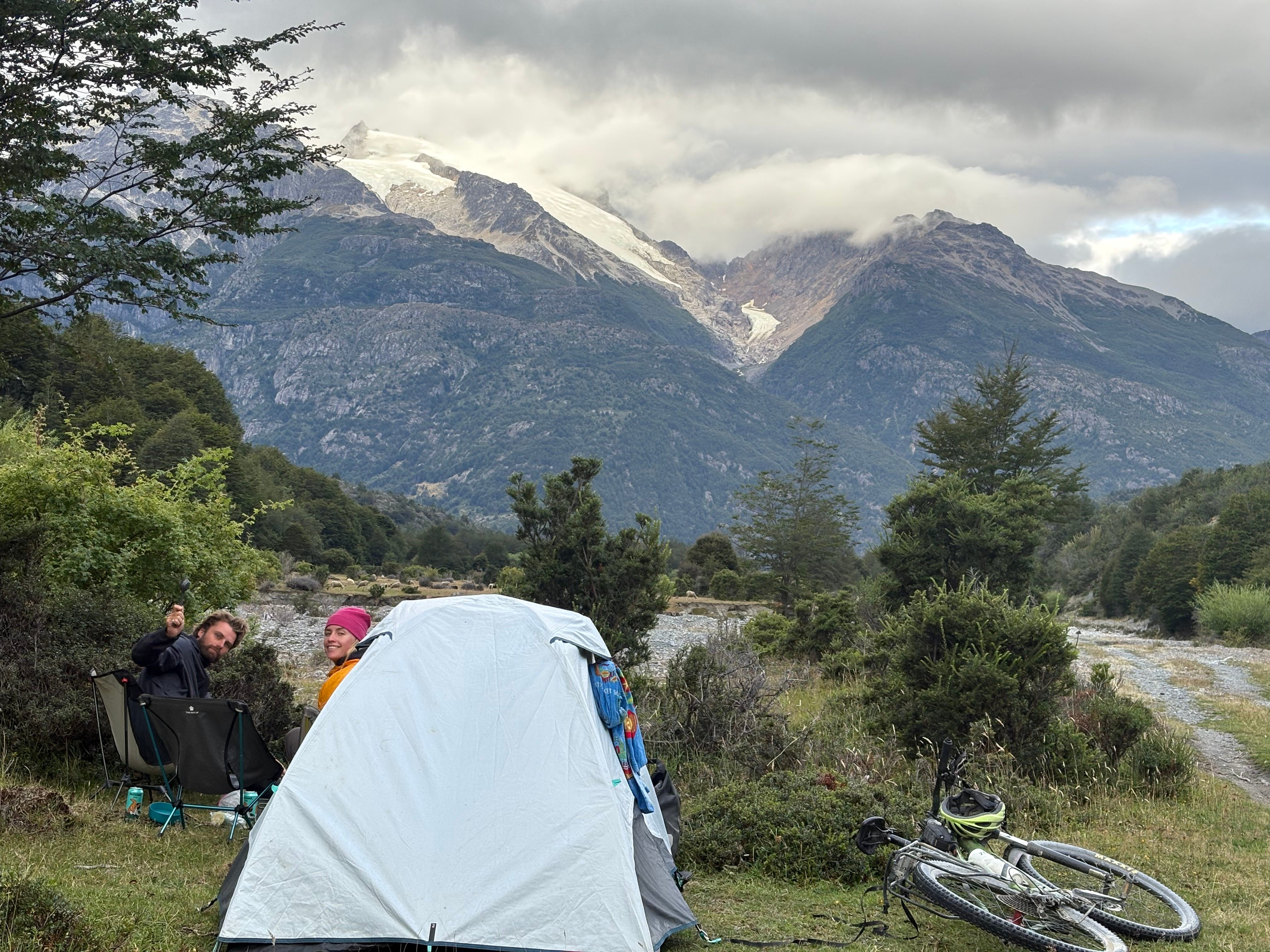
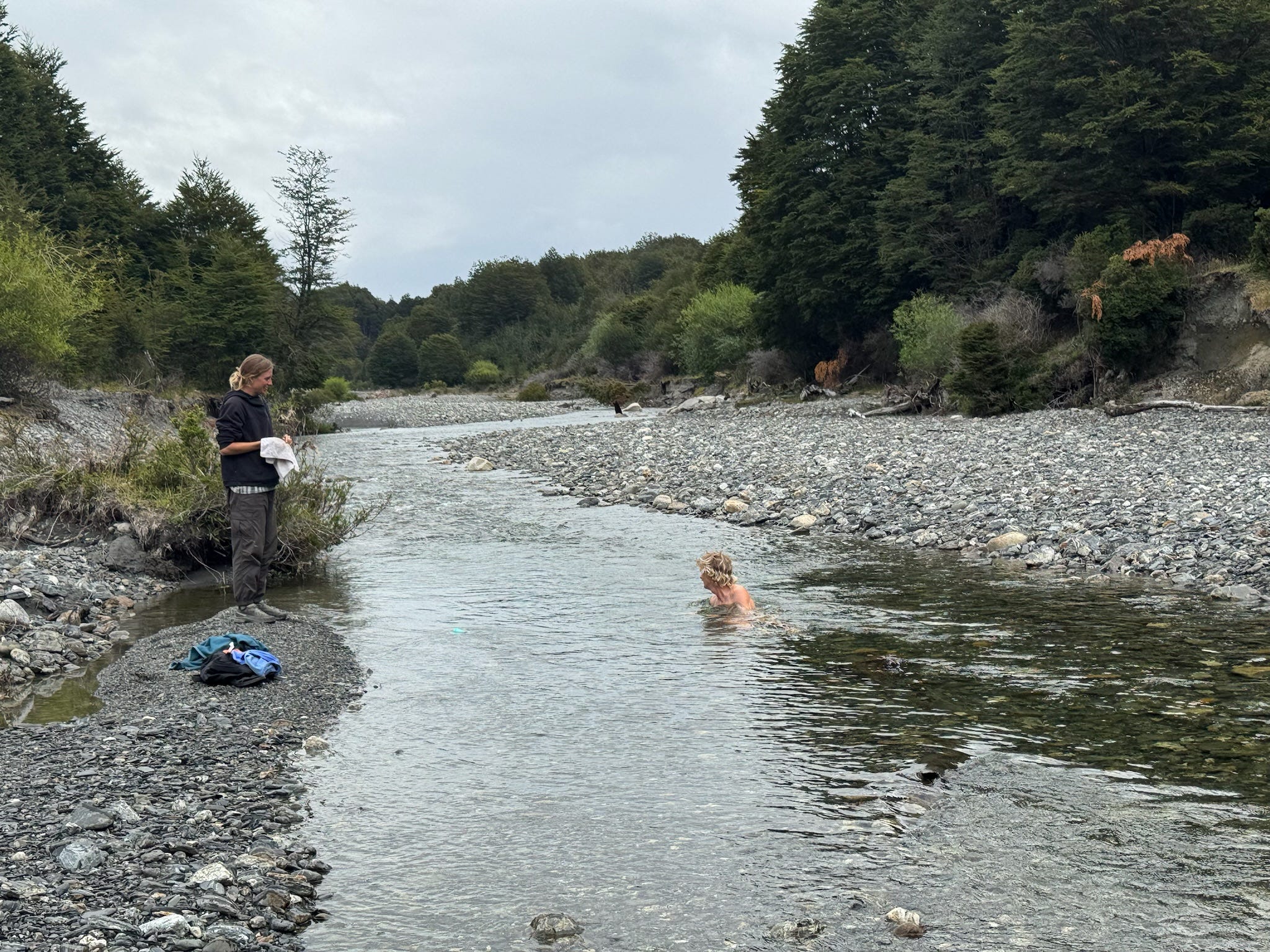
It was beautiful, wild and remote. It the far distance we could see the last of the Northern Icefield, slipping out of view as we pushed on south. After a fairly easy first day, we set up camp by a river with a panoramic view of the mountains, There was even time for a quick, albeit chilly, wash.
Landlocked (kind of)
We rode on along the Rio Baker, whose course we were still following on its journey out to the sea. Finally, the Carretera parted ways with the river and took us up over a pass through the Laguna Caiquenes National Reserve; all of a sudden we were once again surrounded by the temperate rainforest, signalling that we had finally made it back to the coast. We took the last ferry of the day from Puerto Yungay across the fjord, to the mouth of the Rio Bravo. Despite being on the mainland South American continent, there was now no way out of where we were other than boat or plane. It was a surreal feeling.


Under the bridge
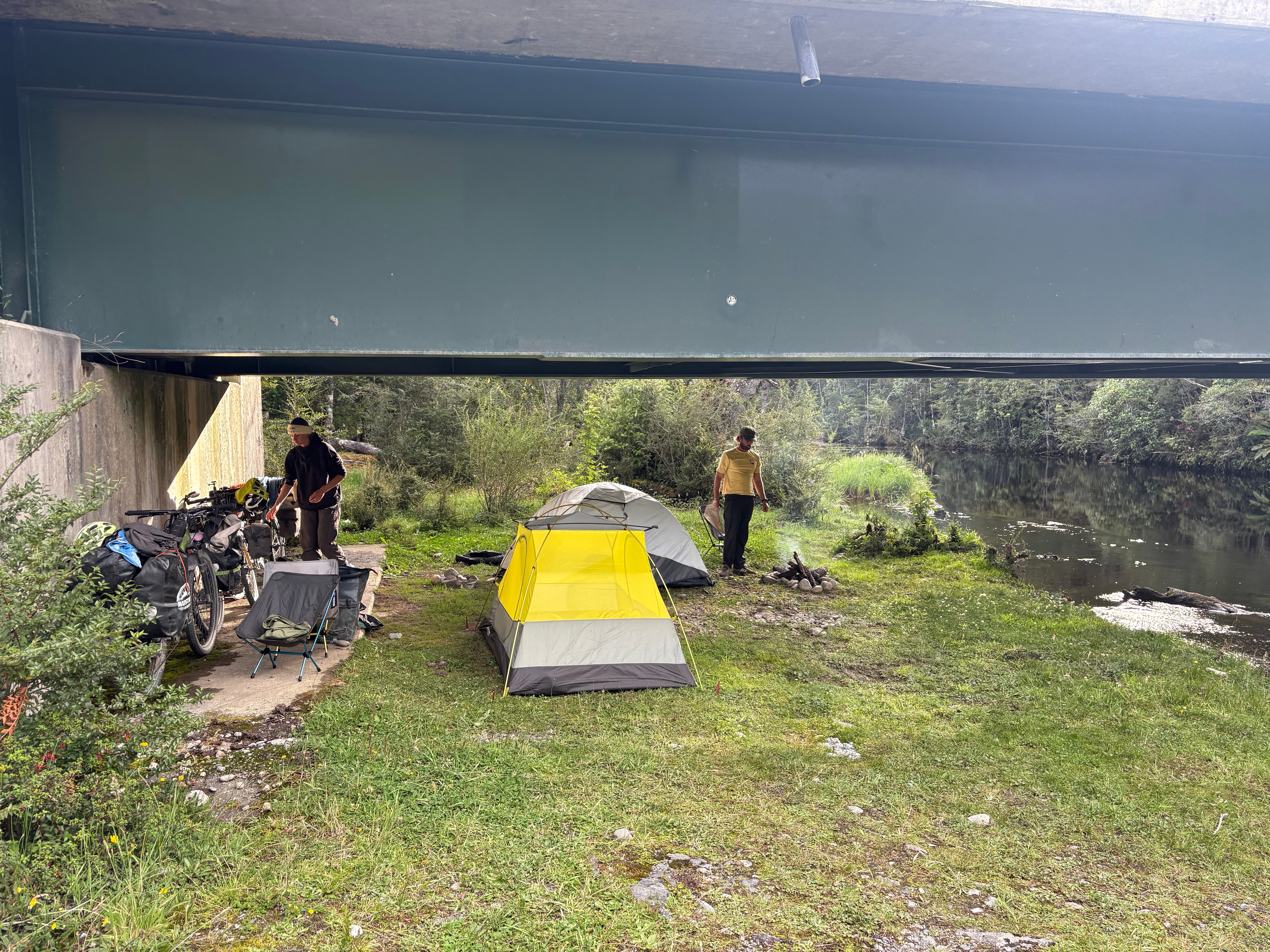
It’s a right of passage to camp underneath a bridge in Patagonia. They’re well suited to cyclists, due to the fact that 1) they’re often flat and 2) it’s a ready made roof to protect you from the elements. With the forecast, once again, indicating big rain we pitched up under one that came well recommended on iOverlander. Despite having a more than ideal amount of human poo around, it served us well as the heavens opened.
Last night on the road
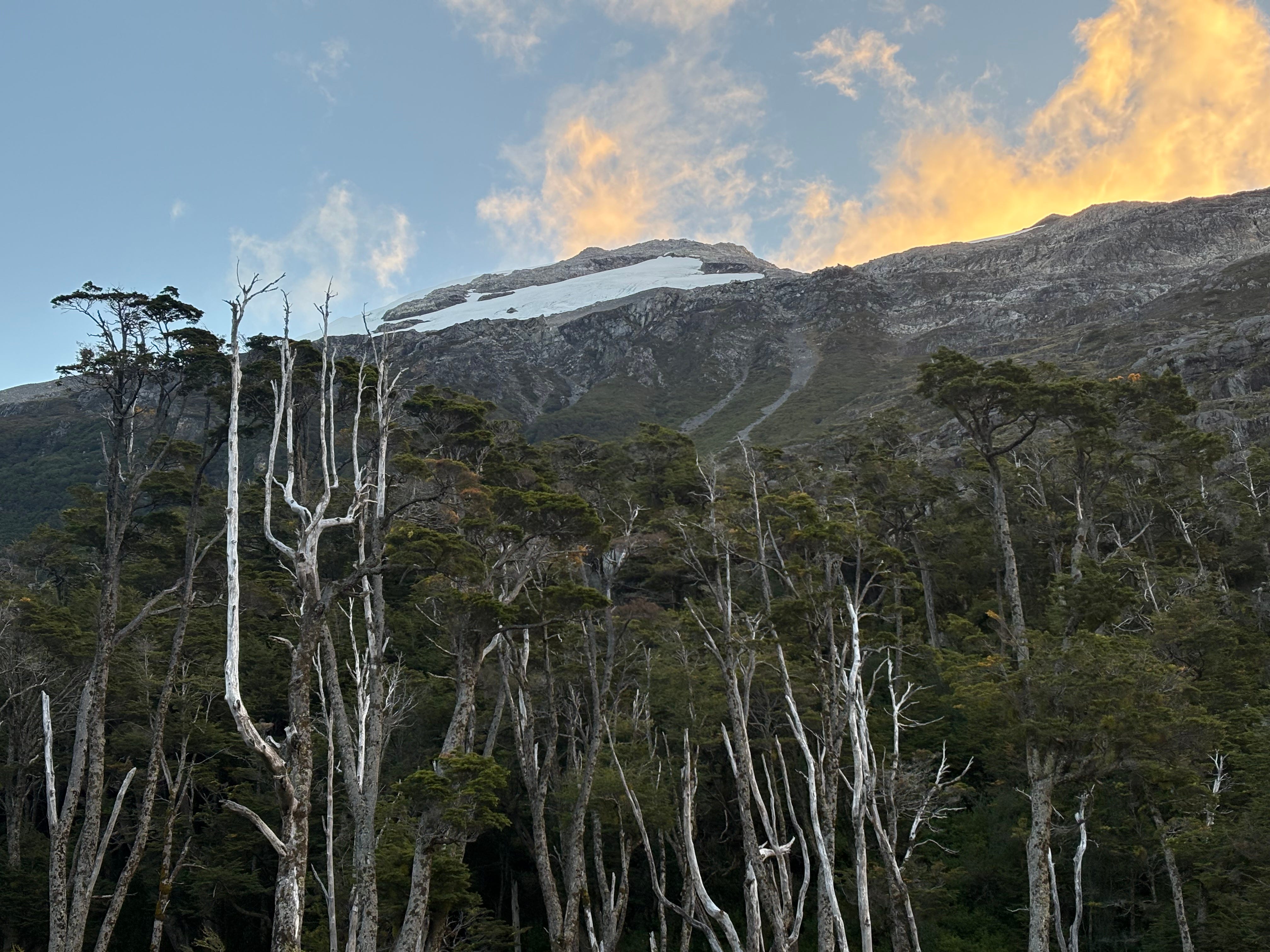
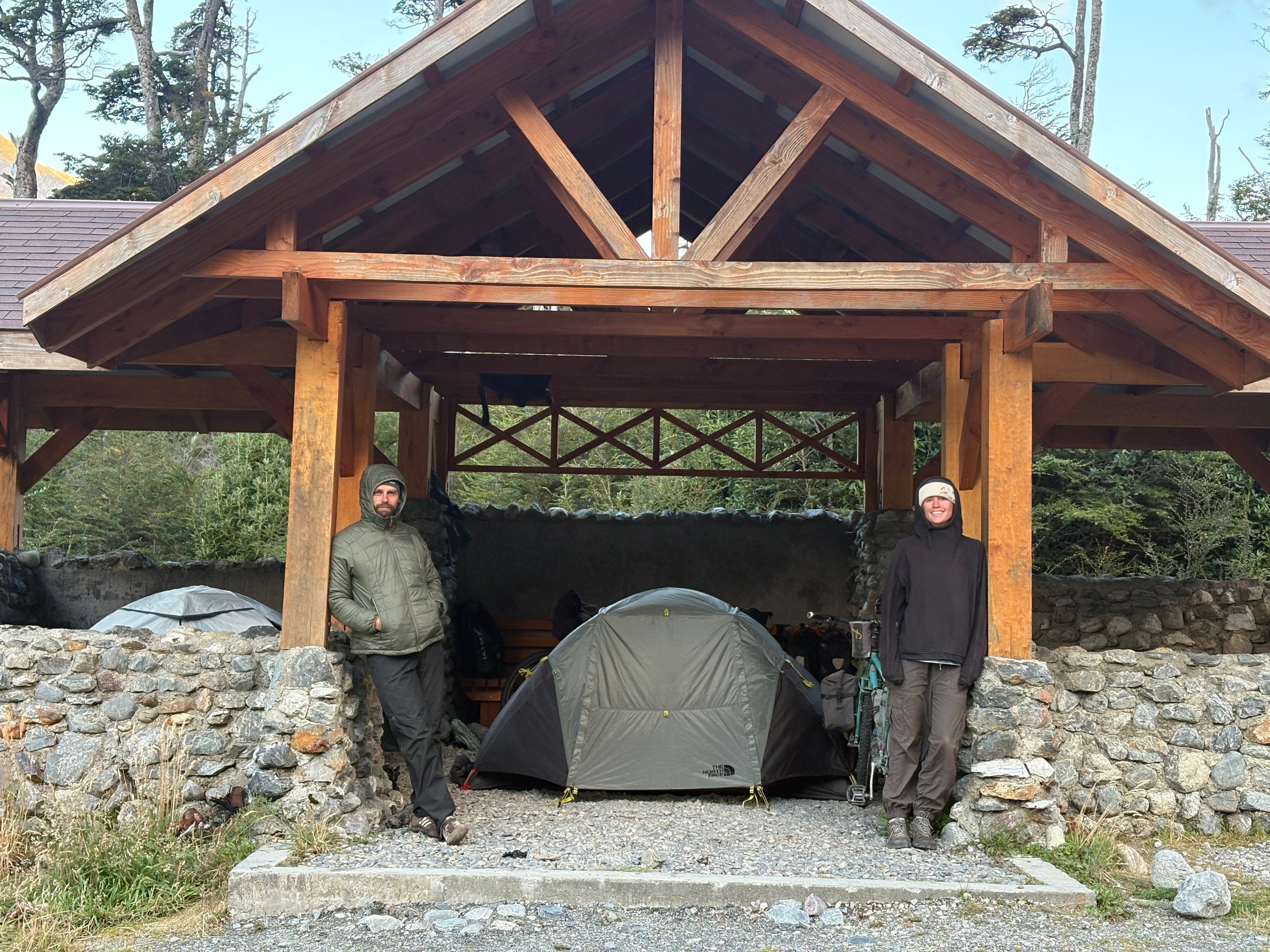
Fittingly, we set off in pouring rain for our final push down to the end of the line. It was tough, frigid day, with the wintery mix making a reappearance as we hauled ourselves up the last gravel pass of the Carretera. Eventually, we topped out into the hanging valley that sits at the base of the Cordon Gran Nevado, which would lead us all the way down to Villa O’Higgins and the Lago of the same name. As we rode the last few km’s to the roadside shelter that would be our home for the night, the weather broke and the sun began to glisten on the endless glaciers and cascading waterfalls that towered overhead. It a magical, beautiful, end to the day.
The end of the line
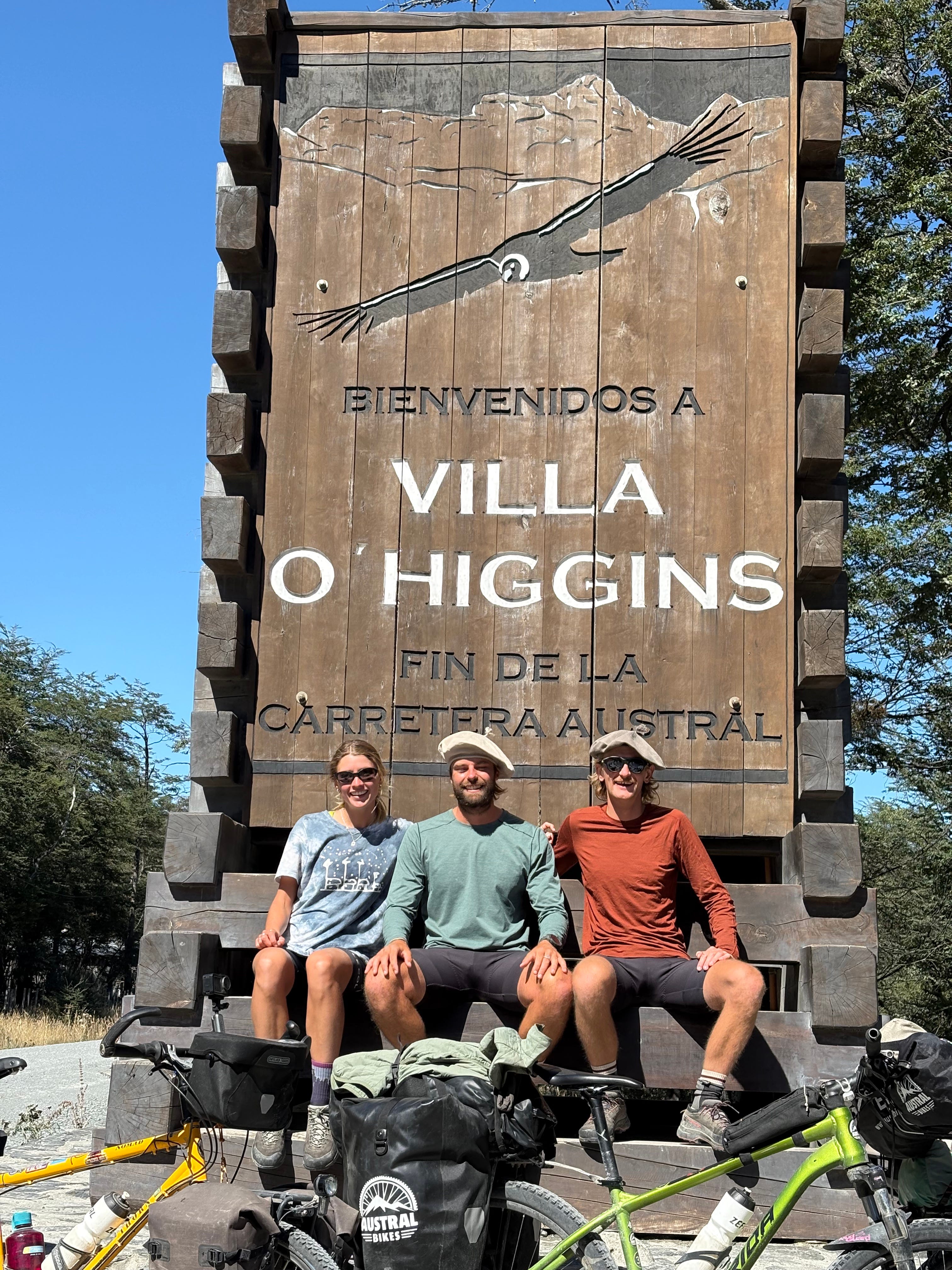
The next morning we cruised down the final section of road in glorious sunshine. As ever, the Carretera treated us to jaw droppingly beautiful views everywhere we looked. Which pretty much sums the Southern Road up. It is a relentless stream of ever changing, ever surprising, otherworldly beauty from kilometre 0 to kilometre 1200. All killer, no filler. Without doubt, the world’s most beautiful road.


A word on our companion
Cycle touring isn’t easy. Cycle touring in Patagonia is even harder. Wild weather, big climbs, gravel roads, agricultural camp spots - it’s not for the faint of heart. Poy, having never done a day of it in his life, threw himself straight in the deep end and met the challenge head on. Through the three and half weeks on the road, we crossed paths with countless other cyclists, many of whom looked like (or said that) they were deeply regretting heading into the wild on their bicycles. You don’t need the perfect bike. You don’t need the best kit. You just need a sense of adventure, a good set of minerals, and the ability to keep laughing in the tough times*. Poy has all of that in spades, and it was special to have a close friend and great riding companion join us for this amazing section of our trip. Hopefully, he’ll be off on his next bike trip soon. Although as Etienne rightly pointed out, it’s tough to know where to go next when you’ve started with the best cycle touring trip in the world…
*high quality waterproof also recommended.
The Deep South
There’s only one way out of Villa O’Higgins (save for a long painful trudge back up the Carretera). A wild border crossing into Argentina via two ferries, a 20km hike and a 40km ride along the top edge of the South Patagonian Icefield (which takes the title of biggest lump of ice outside of the poles). The journey is heavily weather dependent; it’s easy to get trapped in Villa O’Higgins for over a week, waiting for a window. We booked ourselves on the crossing on the 26th Feb, allowing ourselves day of R+R before the next stage of madness (hopefully) began. Late on the evening of the 25th, we got word - good news, the crossing would go ahead. Bad news, it was being brought forward to a 5am departure from the dock to beat an incoming storm. Alarms set for 3.30am, straight into a 10km ride to the dock. The fun just don’t stop.
Well done Poy. Almost a tear in my eye when I read your little summary. Etienne is so right- how fo u top that ?? Mum x
Yet again enthralling and inspiring … such a good read 👌